
Engineering Guide · 2 min read
ASTM A194 austenitic stainless nuts in the Grade 8 family and 9C
Identify sixteen Grade 8 types and Grade 9C by their alloy designations, then check the manufacturing condition on the order.
The short answer. For a drawing that calls for 8MA, start with 8M, the Type 316 composition, then read the final A as a requirement for solution treatment after the nut is formed or machined. ASTM A194/A194M-24 identifies sixteen base types in the Grade 8 family. Grade 9C brings the austenitic group to seventeen. [1]
This part of the ASTM A194 nut grade guide covers austenitic stainless grades and the different conditions available in Type 316.
Which alloy goes with the nut mark?
| Nut designation | Material identification in the 2024 edition |
|---|---|
| 8 | 304 (S30400) |
| 8M | 316 (S31600) |
| 8N | 304N (S30451) |
| 8LN | 304LN (S30453) |
| 8MN | 316N (S31651) |
| 8MLN | 316LN (S31653) |
| 8C | 347 (S34700) |
| 8T | 321 (S32100) |
| 8CLN | 347LN (S34751) |
| 8CLNCuB | S34752 |
| 8F | 303 (S30300) / 303Se (S30323) |
| 8P | 305 (S30500) |
| 8R | XM-19 (S20910) |
| 8S | S21800 |
| 8MLCuN | S31254 |
| 8ML4CuN | S31730 |
| 9C | N08367 |
The two copper-bearing types 8MLCuN and 8ML4CuN are easy to transpose. The former calls for 6.0–6.5% molybdenum by mass and the latter for 3.0–4.0% in the 2024 edition. Even their UNS numbers differ. [1]
The B in 8CLNCuB is part of the base type. For a nut machined from bar in the ordinary condition, the mark is 8CLNCuBB. If the finished nut receives the solution treatment specified for the A condition, the mark is 8CLNCuBA. Match the complete mark in Table 7 before looking up the chemistry in Table 1. [1]
Solution treatment or strain hardening?
Start with the full mark on the nut. An ordinary 8M nut has a finished hardness range of 126–300 HBW. An 8MB mark identifies a nut machined from bar. With 8MA, the finished nut receives a solution heat treatment after forming or machining and the hardness range narrows to 126–192 HBW. All three use Type 316 steel. [1]
If a stainless steel joint needs greater strength, the order can call for strain hardening under S1. Cold working raises the proof load while retaining the same alloy. At ¾–10 UNC, an ordinary 8M heavy hex nut must sustain 26,720 lbf. The S1 nut must sustain 41,750 lbf, about 56% more. At 1–8 UNC the increase is about 44%. Read the S1 proof load for the actual thread size and nut style. [1]
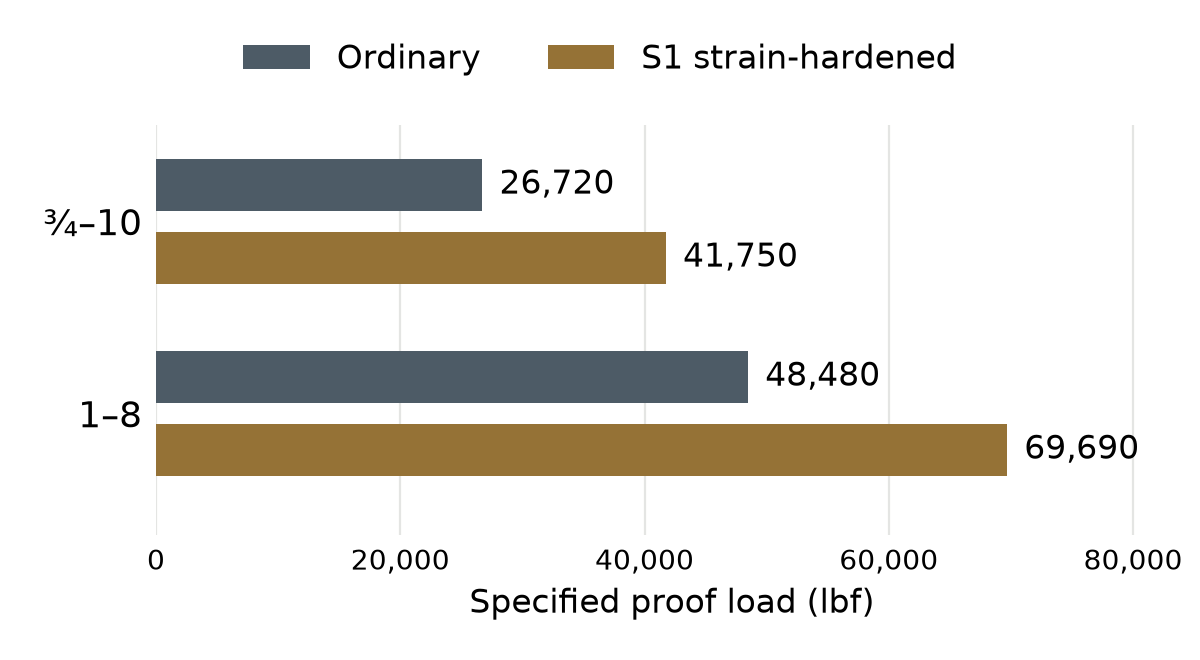
The 2024 edition offers S1 for 8, 8C, 8T, 8M, 8F, 8P, 8N and 8MN. An underline on the grade mark identifies the strain-hardened condition. The ordinary Table 2 hardness limits do not apply. When a drawing specifies S1, carry it onto the nut line independently of the stud class. [1]
To compare these stainless options with the carbon and alloy steel families, return to the ASTM A194 grade index.
References
- ASTM A194/A194M-24. Tables 1–3, 7 and S1.1, pp. 3–6 and 9–10. Sections 6 and 8 and supplementary requirements S1, S3 and S10.