
Engineering Guide · 7 min read
D665A and D667 Stainless Steel Explained: Q/TTPT001-2018
What China’s D-grade names mean, from D665A, D665ANY, D666, D667, D669 and D669B to D671LS, D900 and D900C, and how to check a supplier’s material specification.
The short answer: D665A and D667 are Chinese mill grades for high-manganese, low-nickel austenitic stainless steel. The names appear in company specifications published by Tsingtuo and Ruipu. Tsingtuo is part of Tsingshan (Qingshan), a Chinese industrial group. These D designations are not AISI type numbers, UNS identifiers or Chinese GB grades.[1][2][8]
On a Chinese stainless-wire purchase order, “665” may be shorthand with the D prefix omitted. Confirm the full grade name and suffix before ordering.[1][4]
What does a D-grade name tell you?
A mill grade is a steel producer’s own designation. Tsingtuo (青拓), part of Tsingshan, issues Q/TTPT specifications. Ruipu (瑞浦) issues the separate Q/RP specifications cited here. The document number and year identify the requirements to check. Enterprise specifications can use GB/T test methods while retaining their own mill grade names.[1][2][8]
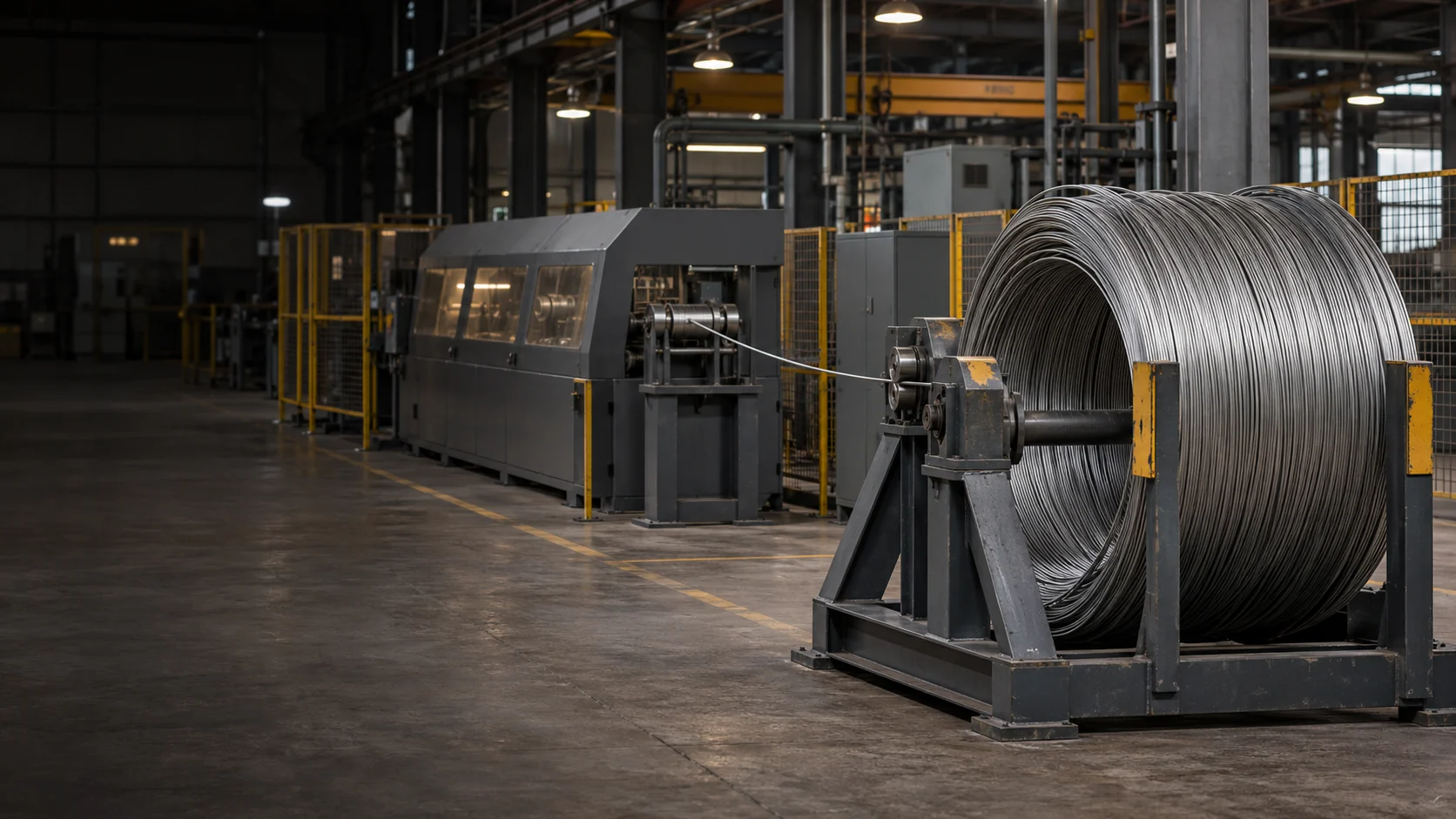
Wire rod is hot-rolled steel supplied in coils for further processing. It can be drawn into smaller wire or prepared for forming operations. Cold heading forms a part by pressing the material in dies; it is used to make fastener heads and other shapes.[1][9] A grade listed for wire rod describes the starting material. The finished screw or bolt still needs its own dimensional and mechanical requirements.
The six historical grades below are classified as 200-series austenitic steels in Tsingtuo’s specification. “Austenitic” describes the steel’s metallurgical structure. In Cr-Mn alloys, manganese and nitrogen help stabilize that structure with less nickel; copper can improve cold formability. The amounts of these elements vary between grades.[1][6]
D665A, D665ANY, D666, D667, D669 and D669B composition
Tsingtuo Q/TTPT001-2018, Table 2, gives the following selected chemical requirements. These are historical heat-analysis limits—requirements for the chemistry of a melt—not typical values or measurements of a shipment. All figures are percentages by mass.[1]
Read the symbols: C = carbon; Mn = manganese; Cr = chromium; Ni = nickel; Cu = copper; N = nitrogen. A range has a lower and upper limit. “≤2.00” means at most 2.00%, not an exact 2.00% content.
| Mill grade | C | Mn | Cr | Ni | Cu | N |
|---|---|---|---|---|---|---|
| D665A | ≤0.08 | 12.50–16.00 | 9.50–11.50 | ≤2.00 | ≤1.00 | ≤0.10 |
| D665ANY | ≤0.10 | 12.50–16.00 | 9.50–11.50 | ≤2.00 | ≤1.00 | ≤0.15 |
| D666 | 0.05–0.10 | 12.00–13.50 | 12.50–14.50 | ≤2.00 | 1.50–2.20 | 0.10–0.20 |
| D667 | ≤0.08 | 12.50–14.50 | 12.50–14.50 | 0.70–2.00 | 1.80–2.50 | ≤0.10 |
| D669 | 0.06–0.10 | 13.50–16.00 | 10.50–12.50 | ≤2.00 | 0.60–1.20 | ≤0.20 |
| D669B | 0.06–0.12 | 17.00–19.00 | 10.50–12.00 | ≤2.00 | 0.60–1.20 | ≤0.20 |
The same six rows also specify Si ≤1.00%, P ≤0.050% and S ≤0.030%. Use the cited document’s full requirements when purchasing. For analysis of the finished product, apply the product-analysis tolerances required by the relevant specification; both cited chemistry specifications refer to GB/T 222 for those tolerances.[1][4]
The figure compares the specified chromium and manganese intervals. Each line runs from the minimum to the maximum.

D665A and D665ANY
D665ANY permits more carbon and nitrogen than D665A: C ≤0.10% and N ≤0.15%, compared with C ≤0.08% and N ≤0.10%. Their Mn, Cr, Ni and Cu limits in this table are the same. Keep the full suffix on the purchase order and material certificate.[1]
D666 and D667
Both specify Cr 12.50–14.50%, but their nitrogen requirements differ: D666 specifies N 0.10–0.20%, while D667 specifies N ≤0.10%. Their carbon, manganese, nickel and copper limits also differ. A quotation for D666 therefore needs checking against a drawing or order that names D667.[1]
D669 and D669B
D669B has a higher specified manganese range: 17.00–19.00%, compared with 13.50–16.00% for D669. Its carbon upper limit is also higher, while its chromium upper limit is lower. The full designation distinguishes these requirements.[1]
Which D grades were listed for cold heading?
Tsingtuo’s 2018 specification separates uses in Appendix A. The distinctions help a buyer understand why a supplier may recommend one D grade for heading and another for wire products.[1]
| Grade or grades | Listed applications |
|---|---|
| D665A | Cold-headed fasteners |
| D665ANY; D667 | Stainless steel wire and spring wire; cold-headed fasteners |
| D666; D669; D669B | Stainless steel wire and spring wire |
An unmarked use in that appendix is not a prohibition. Confirm the proposed wire’s condition and forming suitability with its supplier. The standard’s wire-rod tensile limits also apply to the named delivery condition, not to a finished bolt’s minimum strength.[1] For a finished part, keep the material grade separate from the fastener’s strength class.
Why do D names remain after Ruipu’s 2021 revision?
Ruipu Q/RP 007-2021 replaced Q/RP 007-2018 and explicitly removed all six names discussed above. That change concerns Ruipu’s document. Tsingtuo’s published long-products catalogue lists D665A, D665ANY, D666, D667 and D669 in its Cr-Mn wire-rod group; its application table includes D667 for cold heading. The catalogue identifies names and applications, rather than the requirements for a specific order.[2][3]
When a supplier quotes an older D name, ask which document defines the supplied material today. Keep Tsingtuo’s Q/TTPT documents separate from Ruipu’s Q/RP documents, and retain the edition year. The 2021 deletion list gives no one-to-one replacement grades.[2]
D671LS, D900 and D900C: are there more than six D names?
Yes. D671LS is another documented producer grade, but it is a different kind of steel. Ruipu Q/RP 008-2021 lists it as a martensitic free-cutting stainless steel wire-rod grade. Free-cutting describes material intended for machining. It belongs in a separate comparison from the six austenitic Cr-Mn grades above.[4]
| C | Cr | Mn | Ni | S |
|---|---|---|---|---|
| 0.28–0.35 | 12.00–14.00 | ≤1.25 | ≤0.60 | 0.16–0.20 |
D900 and D900C also appear as names in Chinese stainless wire-rod market listings.[7] For either name, obtain the producing mill’s own composition sheet and supply specification before comparing it with the six historical grades above.
Is D665A or D667 equivalent to Type 201?
The published compositions differ from Type 201 / UNS S20100. ATI’s 201 data gives Cr 16.0–18.0%, Ni 3.5–5.5% and Mn 5.50–7.50%. Every one of the six historical D grades in the first table has lower specified chromium and nickel ranges or limits. “200 series” is a broad family description, not confirmation of Type 201 composition.[1][5]
If a drawing names Type 201, 304 or another standardized grade, request material meeting that exact specification. Treat a proposed D-grade alternative as a material substitution for the drawing owner to review. Chromium contributes to corrosion resistance, while the complete composition and material condition affect behavior; a composition chart alone cannot establish suitability for a particular environment.[6]
What should an inquiry for a D grade include?
State the full grade name and ask the supplier to identify its specification. Include the following information, whether you are buying wire or a finished part.
| Item | What to state or request |
|---|---|
| Grade and producer | The complete name, including ANY, B or LS, and the actual producing mill. |
| Specification | The enterprise document number and year, plus any agreed technical specification. |
| Product and condition | Wire rod, drawn wire, bar or finished part; size, surface and delivery condition. |
| Material certificate | The heat number for the supplied material and its chemical analysis, identifying heat analysis or product analysis and covering the required elements. |
| Finished-part requirements | The drawing, required mechanical properties and relevant exposure conditions. |
For an introductory check of the six Cr-Mn grades, compare C, Mn, Cr, Ni, Cu and N first, then verify the remaining requirements in the specified document. If the product is a bolt or screw, use the bolt specification checklist to complete the finished-part specification.
Send the drawing, full material designation and available material certificate when requesting a fastener quotation.
References
- Tsingtuo Group Co., Ltd. Q/TTPT001-2018 — Stainless Steel Wire Rod, text issued May 10, 2018. The archived file carries a watermark recording a subsequent revision on September 1, 2018. Historical data: Table 2, printed p. 5 / PDF p. 6; Table 3; Appendix A, printed p. 11 / PDF p. 13. Original document hosted by Qichacha.
- Ruipu Technology Group Co., Ltd. Q/RP 007-2021 — Stainless Steel Wire Rod. Scanned original hosted by Shanghai Julang: foreword, printed p. 1 / PDF p. 2, and clauses 4 and 6.1.1. Replaces Q/RP 007-2018 and lists the six D-grade deletions.
- Tsingtuo Group. Long Product Manual, pp. 4, 20 and 24, accessed November 15, 2026. No edition date is stated in the cited catalogue. Company background, Cr-Mn wire-rod names and listed applications; catalogue listings are distinct from batch certificates.
- Ruipu Technology Group Co., Ltd. Q/RP 008-2021 — Free-Cutting Stainless Steel Wire Rods. Table 2, row 18, printed p. 4 / PDF p. 6: D671LS classification and chemistry. Original document hosted by Tianyancha.
- ATI. ATI 201 HP — UNS S20100. Published composition; plate and sheet mechanical values are not used for the D wire grades.
- Euro Inox. Austenitic Chromium-Manganese Stainless Steels — A European Approach, first edition, 2012, Materials and Applications Series, Vol. 12. Alloy-family background and the roles of manganese, nitrogen, copper and chromium.
- Mysteel. Jinhua market: 200-series stainless steel wire rod, November 5, 2026. Cited only for the appearance of D900 and D900C names in the listing, not for chemical requirements or prices.
- Tsingshan Holding Group. Stainless Steel Manufacturing. Corporate description of the Chinese production bases and Tsingtuo’s relationship to Tsingshan.
- Carpenter Technology. Heading Hints: A Guide to Cold Forming Specialty Alloys, Chapter 1, “Heading Basics.” Forming-process explanation; cited for the process, not for D-grade performance.