
Engineering Guide · 4 min read
Bolt Grades 8.8, 10.9 and 12.9: What the Numbers Really Mean
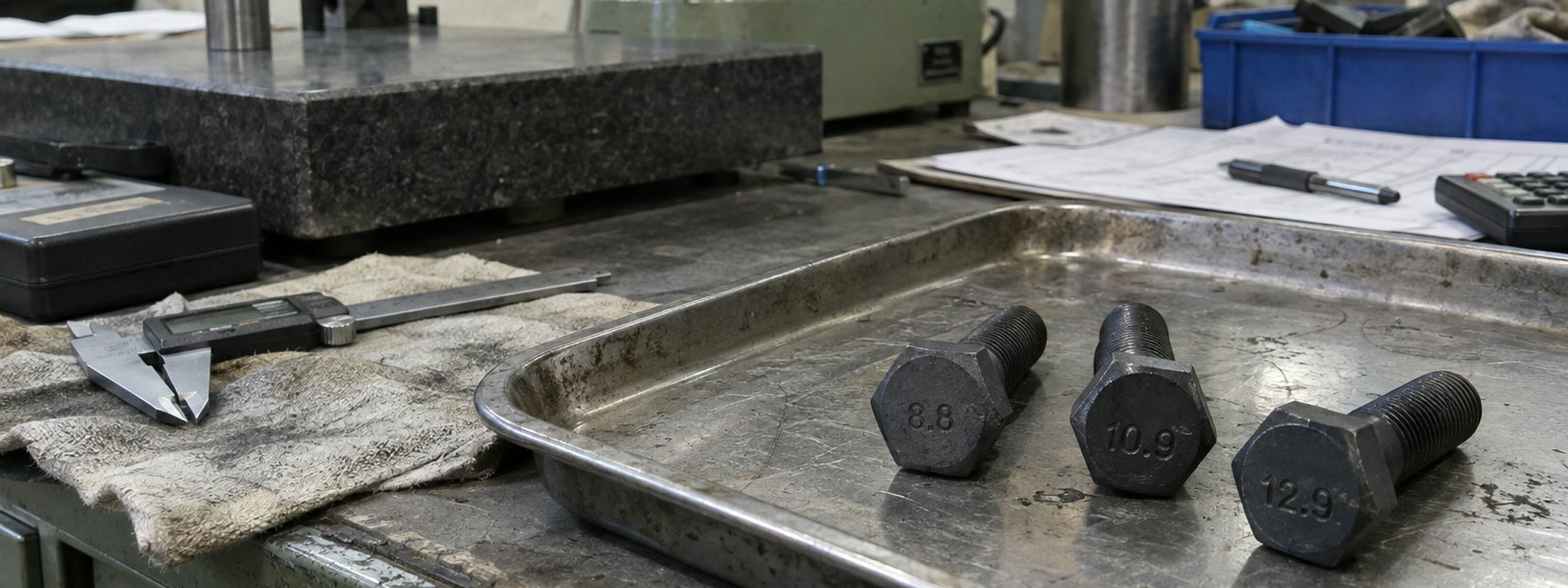
The 8.8, 10.9 and 12.9 marks encode nominal strength—not torque or complete joint capacity. This guide explains the numbers and the checks that still matter.
The short answer: 8.8 is the usual general-purpose high-strength class, 10.9 supports higher preload or a more compact joint, and 12.9 provides the highest nominal strength of the three. Moving up the scale is not an automatic upgrade: fatigue, toughness, hydrogen embrittlement, coating choice, nut compatibility and installation control can make a lower class the better engineering decision.
What do the two numbers mean?
For carbon- and alloy-steel metric bolts, screws and studs covered by ISO 898-1, the property class is a compact strength code. The first number multiplied by 100 gives the nominal tensile-strength level in MPa. The second number, divided by 10, gives the nominal ratio of yield or stress-at-non-proportional-elongation strength to tensile strength.
| Property class | Nominal tensile level | Nominal strength ratio | Derived nominal yield level | Typical role |
|---|---|---|---|---|
| 8.8 | 800 MPa | 0.8 | 640 MPa | General machinery, structures and automotive assemblies |
| 10.9 | 1,000 MPa | 0.9 | 900 MPa | Higher-preload and space-limited joints |
| 12.9 | 1,200 MPa | 0.9 | 1,080 MPa | Highly loaded socket screws and specialised machinery |
These values explain the designation; they are not a complete acceptance table or design allowable. Minimum tensile strength, proof load, hardness, elongation and reduction of area vary with diameter, product type and the applicable clauses of ISO 898-1.[1]
Higher strength changes the whole joint
A stronger bolt can develop more clamp load in the same envelope, but the connected parts must be able to use it. Check the internal thread, nut, washer and bearing surface before increasing the property class. A 12.9 screw driven into a short aluminium thread can simply move the failure from the bolt to the parent material.
The same applies to fatigue. A well-preloaded high-strength fastener can improve resistance to fluctuating external load because the clamped joint carries much of that variation. If the joint separates, slips or has a severe first-thread stress concentration, the higher catalogue tensile number does not rescue the design. Geometry, preload and load path still dominate.
8.8, 10.9 or 12.9?
| Class | Where it makes sense | What to verify |
|---|---|---|
| 8.8 | Routine structural and machinery joints with sensible bolt size | Required preload, service temperature, coating and matching nut |
| 10.9 | Higher clamp load is needed without increasing diameter | Fatigue duty, thread strength, installation method and hydrogen controls |
| 12.9 | Compact, highly loaded joints designed around this class | Toughness, environment, coating process, reuse policy and precise tightening control |
Class 12.9 is common for socket head cap screws, but it is not the default answer for every critical joint. As strength and hardness rise, sensitivity to notches, corrosion damage and hydrogen can become more consequential. If 8.8 supplies the required clamp load with adequate margin, specifying 12.9 may add cost and process risk without improving service life.
The nut and washer are part of the strength system
ISO 898-2 defines property classes and proof-load requirements for metric nuts and gives the intended mating relationships with ISO 898-1 bolts. A stronger bolt does not justify an unverified low nut: internal threads may strip before the bolt reaches its intended load. Hardened washers may also be required to prevent local bearing damage and embedment under a high-strength bolt head or nut.[2]
Do not match the numbers visually. Nut class markings use a different system from the two-number bolt class, and thin nuts have different load capability from regular or high nuts.
Property class does not tell you the torque
Torque depends heavily on thread and bearing friction. Coating, topcoat, lubricant, surface roughness and reuse can change the torque required for the same clamp load. A dry black-oxide 10.9 bolt and a lubricated zinc-flake 10.9 bolt can produce very different tension at the same wrench setting.
Use a tightening specification developed for the actual fastener, nut or tapped hole, finish and lubricant. ISO 16047 provides standard conditions for torque/clamp-force testing; it does not turn the property-class stamp into a universal torque chart.[3]
Coating high-strength fasteners
Electroplated zinc is common, but its cleaning and deposition processes require hydrogen-embrittlement controls. ISO 4042 covers electroplated coating systems and measures intended to reduce that risk. Non-electrolytically applied zinc-flake systems under ISO 10683 are widely used for fasteners at or above 1,000 MPa because they can avoid internal hydrogen introduced by electrodeposition—provided the pretreatment route is also controlled.[4–5]
Baking is a process control, not a guarantee that all absorbed hydrogen has been removed. The coating specification should address pretreatment, embrittlement risk, corrosion performance, dimensional fit and friction, not just colour.
Metric property class is not an SAE grade
SAE J429 covers inch-series steel fasteners using grades such as Grade 5 and Grade 8. Comparisons like “8.8 is roughly SAE Grade 5” are convenient orientation only. The systems differ in dimensions, thread form, proof requirements, chemistry and marking, so an approximate strength comparison does not establish interchangeability.[6]
Stainless designations such as A2-70 and A4-80 also belong to a different standard system. They should not be translated into 8.8 or 10.9 by tensile strength alone.
What to put on the RFQ or drawing
- Fastener and dimensional standard, thread size and property class
- Matching nut class and washer requirements
- Coating system, corrosion test requirement and friction window
- Installation method, target preload or validated torque range
- Service temperature, cyclic loading, corrosive exposure and reuse policy
- Required test report and lot traceability
Coating a 10.9 or 12.9 fastener? Read Dacromet and Zinc-Flake Coatings for High-Strength Fasteners for the practical differences between zinc-flake and electroplated systems, including hydrogen, friction and salt-spray limits.
References
- ISO — ISO 898-1:2013, mechanical properties of carbon- and alloy-steel bolts, screws and studs.
- ISO — ISO 898-2:2022, nuts with specified property classes.
- ISO — ISO 16047, torque/clamp-force testing.
- ISO — ISO 4042:2022, electroplated coating systems.
- ISO — ISO 10683:2018, non-electrolytically applied zinc-flake coating systems.
- SAE International — SAE J429, mechanical and material requirements for mechanical fasteners.