
Engineering Guide · 3 min read
Skipping Final Quenching and Tempering: MFT8, MFT9 and MFT10 (GB/T 28906)
What are MFT8, MFT9 and MFT10 steels? Explore GB/T 28906 composition, B, DP and LB variants, and how processing replaces conventional final quenching and tempering.
The short answer: MFT8, MFT9 and MFT10 are fastener steels designed to develop the required properties through rod processing and cold working without conventional final quenching and tempering. [1]
GB/T 28906-2025 includes base MFT grades and variants specified for different microstructure families. The complete designation identifies which rod chemistry and structure the manufacturer is buying. [1]
This article is part of the Chinese GB/T steel grades series.
What MFT8, MFT9 and MFT10 mean
The MFT prefix identifies non-quenched-and-tempered fastener steel. The number after MFT—8, 9 or 10—identifies a strength category in GB/T 28906-2025; carbon ranges are specified separately in Table 5. Specify the completed fastener’s mechanical property class separately.
The base MFT8, MFT9 and MFT10 grades belong to the ferrite–pearlite type. The standard also lists suffixed grades, including MFT8B, MFT9DP, MFT10LB and MFT12LB, as separate entries in Table 5.
MFT8 and MFT10 composition, with selected variants
| Grade | C (%) | Si (%) | Mn (%) | V (%) | Microstructure family |
|---|---|---|---|---|---|
| MFT8 | 0.18–0.26 | ≤0.30 | 1.20–1.60 | ≤0.08 | Ferrite–pearlite |
| MFT9 | 0.20–0.26 | ≤0.30 | 1.30–1.60 | ≤0.08 | Ferrite–pearlite |
| MFT10 | 0.20–0.28 | ≤0.30 | 1.20–1.60 | 0.03–0.08 | Ferrite–pearlite |
| MFT8B | 0.18–0.23 | ≤0.30 | 0.60–1.20 | — | Ferrite–bainite |
| MFT9DP | ≤0.18 | 0.60–1.40 | 1.25–2.00 | ≤0.10 | Ferrite–martensite |
| MFT10LB | 0.06–0.14 | 0.15–0.35 | 1.90–2.30 | ≤0.10 | Granular bainite |
Composition values are mass percentages. Selected heat-analysis limits, Table 5. The standard includes other grades and agreed additions; these are raw-material limits, not a finished-part strength table. [1]
MFT8, MFT10 and MFT10LB: different C/Mn balances
MFT10LB combines C 0.06–0.14% with Mn 1.90–2.30%; base MFT10 has C 0.20–0.28% and Mn 1.20–1.60%. Their different structure families therefore have clearly different carbon–manganese balances. Base MFT10 also specifies V 0.03–0.08%, while MFT8 and MFT9 list a V maximum without a minimum in Table 5.
What the route gains over conventional quenched steel
In the ML35 carbon family and the 35CrMo / 42CrMo alloy family, conventional quench-and-temper production uses final heat treatment to establish the part condition. The MFT concept shifts the material and manufacturing route so that this final operation is omitted.

Omitting final quenching also avoids the distortion that stage can introduce. The rod structure, drawing reduction and heading deformation become central controls on the completed part.
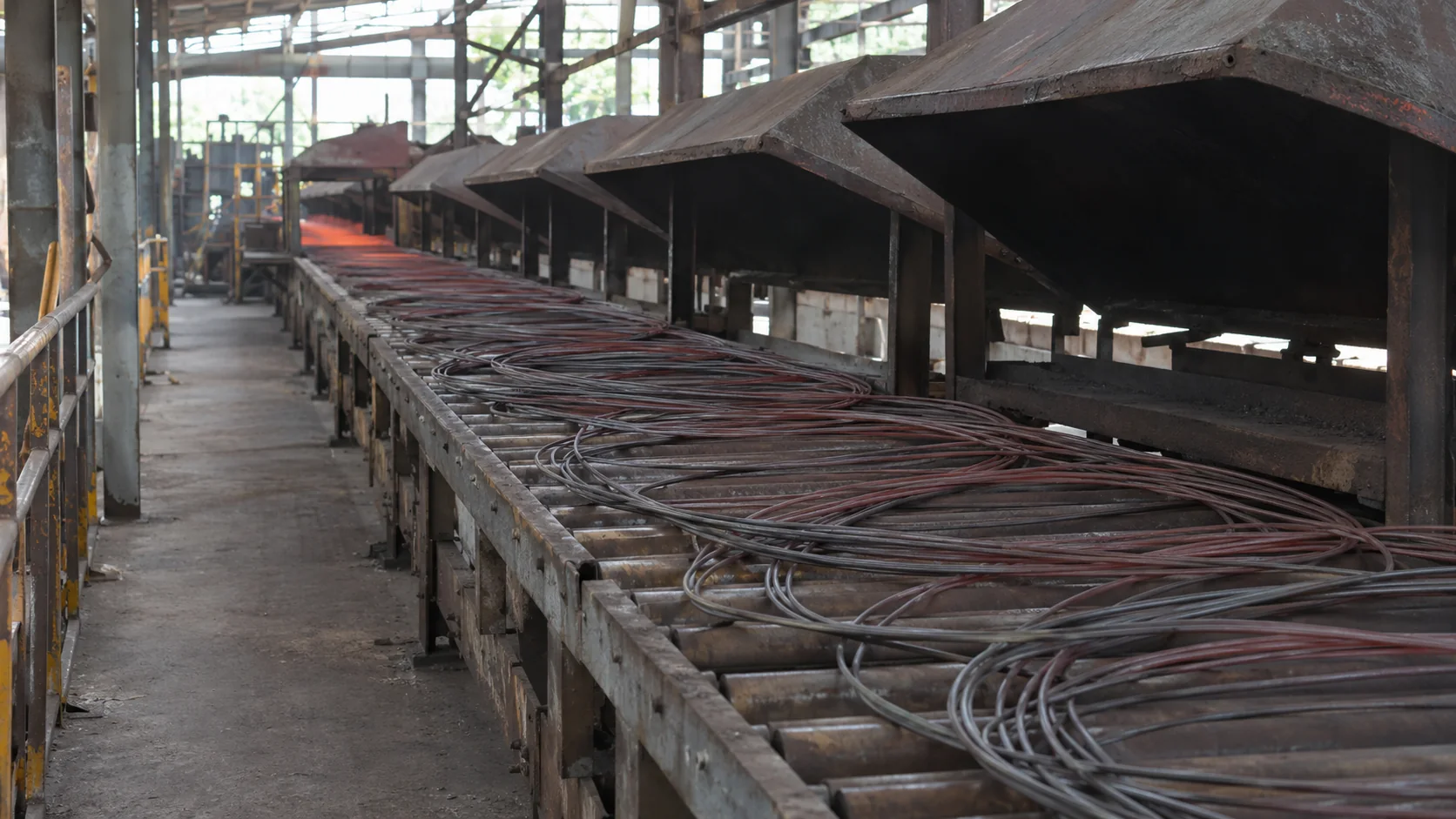
For non-quenched-and-tempered bolt wire, work hardening during drawing builds strength before heading. Controlled rolling and cooling establish the starting structure; downstream deformation changes its strength further. [2] A Chinese MFT8-derived steel study also describes Nb–V microalloying and controlled rolling/cooling to obtain precipitation strengthening, followed by direct drawing and heading. [3]
The B, DP and LB variants
In MFT8B, the suffix B denotes a ferrite–bainite microstructure; in ML20B, B denotes boron. MFT9DP denotes the ferrite–martensite dual-phase family. MFT10LB denotes granular bainite.
GB/T 28906-2025 brings these non-quenched-and-tempered wire-rod families into the current document. It replaced both GB/T 28906-2012 and the former non-quenched-and-tempered wire-rod standard GB/T 29087-2012 when it took effect on October 1, 2025. [1]
Its place at the end of the material series
Selecting an MFT grade includes selecting the downstream drawing and heading route. The rod properties and forming reductions must together deliver the specified strength and ductility.
Return to the Chinese GB/T steel grade guide for the complete category map, selected composition summary and links to all seven material-family articles.
Browse the HexFastener homepage or submit a drawing with the required material callout.
References
- GB/T 28906-2025 — Hot-rolled steel wire rod for cold heading. Official online text; Clause 4 and Tables 1–6.
- Nippon Steel — Development of Bainitic Wire Rod (Multi Free Wire Rod) for Non-heat-treatment Bolt. Technical Report 135, March 2026, pp. 90–92; manufacturing mechanisms, not Chinese MFT grade acceptance values.
- Zhang et al. — Development of niobium-vanadium microalloyed 9.8 grade non-quenched-and-tempered cold-heading steel wire rod. Steel Rolling 39(1), 2022, pp. 115–119; MFT8-derived steel, controlled rolling/cooling and cold working.