
Engineering Guide · 7 min read
RUSPERT and Magni Coatings: ISO 4042 and ISO 10683
RUSPERT and Magni use different coating routes. Compare their layer builds, corrosion data and friction characteristics before choosing a finish for screws or bolts.
The short answer. RUSPERT is a multilayer corrosion-protection system built over a metallic zinc or zinc-nickel deposit. Magni is a coating brand with several fastener products, including the non-electrolytic zinc-rich systems Magni 554 and 565. Their coating routes differ, which is why ISO 4042 and ISO 10683 enter the specification at different points. [1] [2] [3]
This article is part of the Dacromet and zinc-flake coating series. It explains where RUSPERT and Magni fit when these names appear on a fastener quotation.
The layer builds below show the first useful distinction. The metal protecting the steel is deposited differently, even when the finished parts look similar.
| Named system | Layer next to the substrate | Layers above it |
|---|---|---|
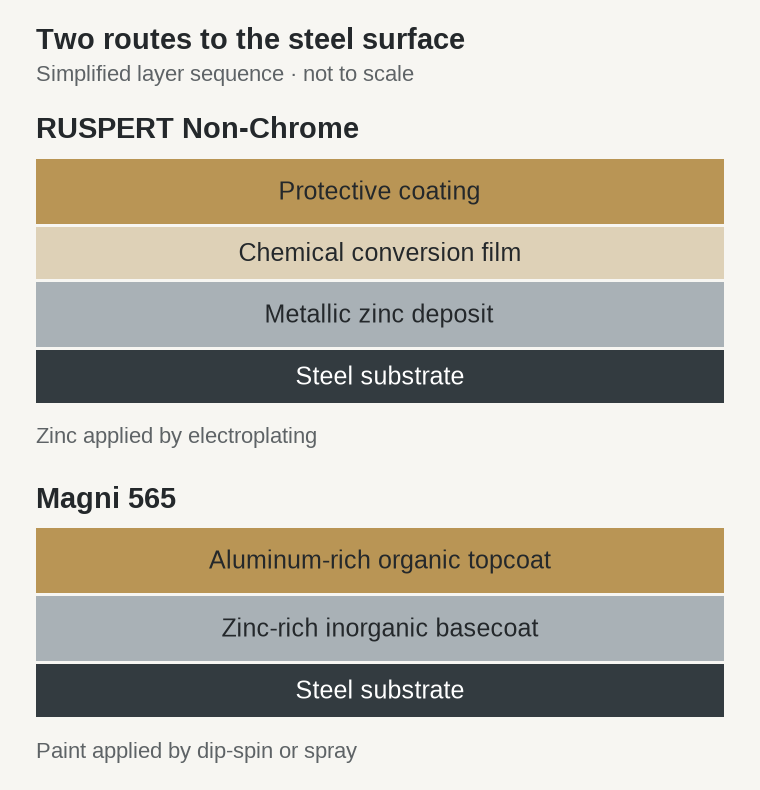
| RUSPERT Non-Chrome | Metallic zinc, 5 μm | Chemical conversion film, 1 μm, then protective coating, 10 μm |
| New RUSPERT | Zinc-nickel alloy plating, 5 μm | Waterborne sealer, 1 μm, then waterborne topcoat, 6 μm |
| Magni 554 | Inorganic zinc-rich basecoat, 8 μm minimum | Organic aluminum-rich topcoat, 5 μm minimum |
| Magni 565 | Inorganic zinc-rich basecoat, 8 μm | Organic aluminum-rich topcoat, 5 μm minimum |
RUSPERT figures are the builds illustrated in the manufacturer's brochures. Magni figures are from its June 2026 and August 2026 data sheets, respectively, whose performance tables are labeled as typical values. These are product-specific examples, not thickness requirements for every finish sold under either brand. [2] [3] [4] [5]
RUSPERT, 热锈宝, 路锈宝 and Magni
Chinese sourcing documents may use 热锈宝 or 路锈宝 for RUSPERT. Nihon Ruspert uses 拉斯派特 on its own Chinese website. These names do not identify separate coating technologies. Specify RUSPERT and the exact treatment variant on an international order. [1] [6] [7]
美加力 refers to Magni. The number that follows it matters. Magni 554 and Magni 565 have different published friction characteristics, even though both use a zinc-rich basecoat and an aluminum-rich organic topcoat. A quotation that says only “Magni coating” leaves the product unresolved. [4] [5] [8]
How they relate to Dacromet
DACROMET and GEOMET belong to NOF's zinc-flake coating technology. In these systems, the protective metal is carried in a coating liquid and applied without electroplating. NOF developed chromium-free GEOMET as the successor to its earlier DACROMET technology. [9]
Magni 554 and 565 use the same broad non-electrolytic approach, with their own basecoat and topcoat formulations. RUSPERT's plated underlayer places it on a different process route. Both approaches combine a zinc-bearing layer with additional protection above it, but the similarity of their gray finishes tells you little about how they were made.
The cross-sections below show the difference at the steel surface. The plated layer is continuous metal. The zinc-rich paint contains protective metal dispersed in a binder.
This distinction also appears within Nihon Ruspert's own range. The company separately offers DISGO, a zinc-flake treatment developed for steel parts such as high-tensile bolts. Its catalog distinguishes that treatment from RUSPERT's combination of plating and coating. The manufacturer's name therefore does not establish the deposition method. [10]
Where ISO 4042 and ISO 10683 apply
ISO 4042:2022, with Amendment 1:2026, covers electroplated fastener coating systems, including zinc and zinc-nickel with conversion coatings, sealants or topcoats. It is the relevant general framework to consider for a plated RUSPERT build. The named RUSPERT treatment and its performance requirements still need to be specified. [11]
ISO 10683:2018 covers non-electrolytically applied zinc-flake systems. Magni lists it for both 554 and 565. This standard is especially relevant to high-strength steel fasteners because the coating deposition avoids the hydrogen introduced by electroplating. The cleaning process before coating still matters. [4] [5] [12]
For a high-strength bolt or a case-hardened screw, changing between these routes is a manufacturing change as well as a corrosion-protection change. ISO 4042 addresses hydrogen-embrittlement controls for electroplated fasteners. A protective topcoat does not remove the need for those controls underneath it. [11]
That is the first selection decision. Establish whether the fastener can use the proposed plating and pretreatment route, then compare what the completed coating must do in the joint.
What the corrosion figures actually compare
New RUSPERT's brochure reports 2,000 hours without red rust in a JIS Z 2371 salt-spray test and 200 cycles without red rust under JASO M609-91. Those results belong to the zinc-nickel, sealer and topcoat combination shown earlier. They should not be assigned to an unspecified RUSPERT finish. [3]
Magni publishes the following figures for its two products. The friction column is included because a fastener must tighten correctly as well as resist corrosion.
| Product and data-sheet date | ASTM B117 salt spray | SAE J2334 cyclic corrosion | ISO 16047 coefficient of friction |
|---|---|---|---|
| Magni 554 June 2026 | 720–1,008 h | 60 cycles minimum | 0.12 ± 0.03 |
| Magni 565 August 2026 | 1,000 h | 120 cycles | 0.15 ± 0.03 Other levels available |
These are manufacturer-published typical values. Magni directs users to the applicable customer specification and application guidelines for the contractual requirements. The short data sheets do not define the rust-evaluation endpoint for these entries. [4] [5]
These figures do not establish which coating will last longer on a building or vehicle. Even a laboratory comparison requires the same test method, rust criterion and specimen condition. Matching those conditions still does not turn salt-spray hours into a service-life prediction. ISO 9227:2022 makes that limitation explicit. [13]
Installation creates another difference. A self-drilling screw cuts through sheet metal before its head seats. For that application, the useful comparison is corrosion behavior after driving into the specified sheet, including the contact area beneath the head and washer. An uninstalled screw's salt-spray result answers only part of that question. Nihon Ruspert's separate CAELAR LB treatment specifically targets corrosion protection after drilling, illustrating why installation damage deserves its own requirement. [10]
Why the Magni friction figures matter
For a bolt tightened to a specified torque, friction helps determine how much clamp force develops. Lower friction generally produces more clamp force at the same torque when the other joint conditions remain unchanged. A coating substitution can therefore change the assembly even when the replacement passes the corrosion test. ISO 16047:2005 provides torque/clamp-force test conditions for the threaded fasteners within its scope. It excludes screws that form their own mating thread, so these friction values do not specify a self-drilling screw's installation torque. [14]
The published ranges above work out to 0.09–0.15 for Magni 554 and 0.12–0.18 for Magni 565. They overlap, but they are not identical. A drawing requiring 0.12–0.18 cannot be satisfied simply by choosing the product with the lower nominal friction. Magni can formulate other friction levels, so the quoted variant and mating test surfaces need to match the assembly requirement.
Coefficient of friction is also different from the torque coefficient, often called the nut factor or K-factor. ISO 16047 treats them as separate quantities. A coefficient of friction of 0.15 is not an instruction to insert K = 0.15 into a bolt-torque calculation. The thread geometry and bearing contact also affect torque. [14]
Choosing the coating for the joint
For a self-drilling screw in exterior cladding, start with the screw supplier's coating option for the actual sheet material and exposure. If RUSPERT is proposed, identify whether it is Non-Chrome, New RUSPERT or another named treatment. Then agree on corrosion performance after installation and confirm the complete screw-and-washer combination.
For a bolt in a torque-controlled assembly, specify the coating build and friction range alongside the corrosion requirement. If Magni is proposed, identify the exact product and friction variant. Include the intended nut and bearing surface in the torque/clamp-force evaluation. A change of color, topcoat or added lubricant belongs in that evaluation too.
For either route, the purchase description should carry the product variant, applicable standard and edition, layer thickness requirements, corrosion method and pass criterion, and any assembly-friction requirement. Add the fastener material, hardness or property class and the required thread fit after coating. This lets the applicator confirm that the coating meets the fastener's dimensional and assembly requirements.
If the drawing also offers GEOMET, the next comparison is within NOF's zinc-flake family. Read What Is GEOMET? 321, 360, 430, 500 and 720 Explained for the differences between its basecoats, lubricated systems and lower-temperature variants.
References
- Nihon Ruspert, Chinese product overview. RUSPERT / 拉斯派特, New RUSPERT and the separate DISGO family.
- Nihon Ruspert, RUSPERT Non-Chrome brochure, pp. 2–4. Layer build and standard treatment process. Undated brochure, retrieved November 25, 2026.
- Nihon Ruspert, New RUSPERT brochure, pp. 2–4. Layer build and manufacturer's corrosion-test results. Undated brochure, retrieved November 25, 2026.
- Magni, Magni 554 Product Data Sheet, June 2026, p. 1.
- Magni, Magni 565 Product Data Sheet, August 2026, p. 1.
- CN103302225A, high-low thread screw manufacturing process, 2013. Cited only for the explicit Chinese name 热锈宝 (RUSPERT).
- SONEC / JFO Steel, bilingual screw catalog, finish-abbreviation key. Finish abbreviation RS, RUSPERT / 路锈宝.
- SFCHINA 2025, official exhibitor directory. Magni / 美加力 bilingual brand entry.
- NOF Metal Coatings, technology history and development of chromium-free GEOMET.
- Nihon Ruspert, English product catalog index. DISGO and CAELAR LB product descriptions.
- ISO 4042:2022, Fasteners — Electroplated coating systems, scope and hydrogen-embrittlement provisions; Amendment 1:2026.
- ISO 10683:2018, Fasteners — Non-electrolytically applied zinc flake coating systems, scope.
- ISO 9227:2022, Corrosion tests in artificial atmospheres — Salt spray tests, scope. Amendment 1:2024 concerns the warning footnote.
- ISO 16047:2005, Fasteners — Torque/clamp force testing, §§5 and 10, with Amendment 1:2012.