

Engineering Guide · 6 min read
DISGO Zinc-Flake Coating: ISO 10683
How DISGO protects fasteners and building hardware, with low-temperature and heavy-duty corrosion-protection options, aluminum-contact corrosion and measured tightening behavior.
The short answer. DISGO is Nihon Ruspert’s chromium-free zinc-flake coating for steel fasteners and building hardware. Its standard process combines mechanical surface preparation with baked basecoats and a topcoat, avoiding acid pickling and electroplating while also helping control corrosion where fasteners contact aluminum. [1] [2]
This article is supplementary reading in the Dacromet and zinc-flake coating series. It explains the DISGO options that matter when specifying a coated fastener.
The first choice is between the low-temperature version and the heavy-duty corrosion-protection version. Their published figures are different:
| DISGO version | Baking temperature shown | Basecoat + topcoat | Published corrosion figures |
|---|---|---|---|
| Low-temperature | 200 °C | 7 + 3 μm | 1,000 h salt spray; 100 corrosion cycles |
| Heavy-duty | 200–250 °C process range | 7–9 + 3 μm | 2,000 h salt spray; 200 corrosion cycles |
These are published coating builds and test figures. The low-temperature example uses M8 × 20 bolts; the corrosion methods are JIS Z 2371 and JASO M609-91. Agree the exact build and the cure temperature and time for each coating pass with the applicator for the parts being ordered. [1] [3]
How DISGO differs from RUSPERT
RUSPERT and DISGO come from the same manufacturer but use different routes to protect steel. The RUSPERT systems discussed in RUSPERT and Magni Coatings: ISO 4042 and ISO 10683 start with a metallic zinc or zinc-nickel deposit. Standard DISGO applies a zinc-flake-rich coating to the prepared substrate. It belongs alongside Dacromet and GEOMET in the wider zinc-flake discussion. [4]
The distinction matters for a hardened bolt. Acid cleaning and electroplating can introduce hydrogen into susceptible steel. DISGO’s blast-prepared route removes those steps from the coating process. The part’s earlier manufacturing history and service environment still matter; a coating choice addresses only part of the fastener’s hydrogen-embrittlement risk. [2] [11]
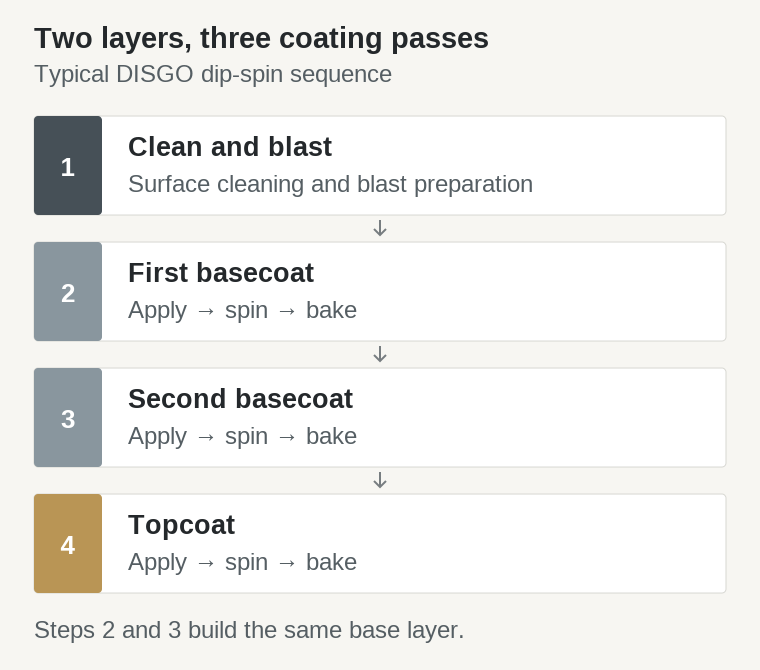
The usual dip-spin sequence builds two functional layers through three coating passes. The basecoat is applied and baked twice before the topcoat is applied and baked.
Keep the full product name on the order. DISGO LUNA, for example, uses a hot-dip galvanized underlayer. It is a separate construction, so the blast-to-zinc-flake sequence above does not describe every product carrying the DISGO name. [7]
Choose the cure before the corrosion rating
A spring or heat-treated screw may limit the temperature and time available for curing its coating. Give the applicator the material, heat-treatment condition and permitted thermal exposure before choosing the DISGO version. The low-temperature product is intended for parts whose properties are sensitive to the coating bake. Its 200 °C treatment temperature is not a 200 °C continuous-service rating. [3]
Once the part can tolerate the cure, compare the required corrosion result. Nihon Ruspert illustrates heavy-duty DISGO on property-class 10.9 bolts with no red rust after 2,000 hours in JIS Z 2371 salt spray and after 200 JASO M609-91 cycles. Those results belong to the tested system. [1]
A 2,000-hour result does not mean twice the outdoor life of a 1,000-hour finish. Salt-spray exposure is a controlled laboratory test; ISO 9227:2022 expressly cautions against using it to rank materials for long-term corrosion resistance. Specify the method, duration, rust criterion and condition of the parts being tested. [8]
Why the aluminum side of the joint matters
In an aluminum bracket secured with steel or stainless steel fasteners, protecting the bolt is only half the corrosion problem. The contact between dissimilar metals also needs attention. Nihon Ruspert describes DISGO’s resin-based topcoat as an electrical barrier that reduces direct contact and galvanic corrosion. [9]
The Building Center of Japan’s BCJ-148 assessment provides a more specific basis for that application. For general building hardware, it evaluated a DISGO system with basecoat and topcoat masses of 25.6 and 7.5 g/m². Its conclusions include reduced corrosion of aluminum in contact with coated steel and stainless steel hardware, compared with the zinc-plated and hot-dip galvanized systems examined. Its corrosion evaluation also included 15 months of outdoor exposure in Kishiwada, Japan. [2]
That makes the assembled joint the useful test specimen. For an outdoor aluminum bracket, ask to evaluate the actual bolt, washer and bracket after tightening, and inspect the aluminum as well as the fastener. The contact surfaces, coating damage and places where water collects are part of that assessment.
The finish changes the required tightening torque
DISGO can be supplied with different friction characteristics. A manufacturer test shows how much that distinction can matter. For each finish, four F10T M22 × 55 assemblies with DISGO-treated bolts, nuts and washers were tightened by turning the nut. The reported averages below all correspond to the same 226 kN axial force. [6]
| Tested DISGO finish | Reported average torque | Reported torque coefficient K |
|---|---|---|
| Low-friction | 681 N·m | 0.137 |
| Low-temperature | 862 N·m | 0.173 |
| Black | 1,020 N·m | 0.205 |
These are results from an undated technical handbook, not current installation settings for an M22 bolt. They show why changing the DISGO finish while keeping the old torque can change the bolt force. The reported K values are torque coefficients, not coefficients of friction. [6]
For a torque-controlled assembly, obtain torque/clamp-force data for the supplied coating, lubricant and mating surfaces. ISO 16047:2005, with Amendment 1:2012, provides a test framework for fasteners within its scope. A label such as “low-friction DISGO” still needs a numerical requirement agreed for the joint. [10]
Specifying DISGO under ISO 10683
ISO 10683:2018 covers non-electrolytically applied zinc-flake systems on steel fasteners, including systems with topcoats and lubricants. It is the relevant general specification to consider for the standard zinc-flake DISGO route. The DISGO name identifies the proprietary treatment; the purchase specification establishes what the finished fastener must meet. ISO 10683 also permits systems with or without hexavalent chromium, so state the required chromium-free finish separately. [5]
A workable order needs five things:
- The fastener: material, strength or hardness, dimensions, thread tolerance and permitted coating-bake exposure.
- The complete finish: exact DISGO version, color, basecoat, topcoat and any lubricant.
- The coating requirement: governing standard and edition, agreed thickness or coating mass, and thread fit after coating.
- The corrosion test: method, duration, rust criterion and whether testing is before or after assembly.
- The joint: mating metals, friction or torque/clamp-force requirement, and repair procedure for installation damage.
That last item matters with a thin film. Nihon Ruspert warns that tightening tools can expose the substrate and calls for damaged areas to be repaired with its DRALL touch-up coating. Agree the repair procedure before installation, particularly where the coating protects contact with aluminum. [1]
If the next decision is between DISGO and a named GEOMET product, continue with What Is GEOMET? 321, 360, 430, 500 and 720 Explained. It compares the curing, lubrication and application differences within that family.
References
- Nihon Ruspert, DISGO brochure, Japanese, pp. 1–4. Heavy-duty figures, layer diagram, tests on class 10.9 bolts and installation-damage guidance. Undated brochure, accessed November 25, 2026.
- Building Center of Japan, BCJ-148 assessment of DISGO corrosion protection for building hardware, pp. 1–3; renewal review completed January 23, 2023. Evaluated coating masses, test conditions, aluminum-contact corrosion and scope.
- Nihon Ruspert, DISGO low-temperature brochure, Japanese, pp. 2–4. The M8 × 20 test specimen uses a 7 μm basecoat and 3 μm topcoat, baked at 200 °C. Undated brochure, accessed November 25, 2026.
- Nihon Ruspert, English product overview. Separate descriptions of RUSPERT, New RUSPERT and DISGO.
- ISO 10683:2018, Fasteners — Non-electrolytically applied zinc flake coating systems. Scope; confirmed in 2023.
- Nihon Ruspert, DISGO technical handbook, bilingual edition hosted by Sunco, printed pp. 5 and 29 (PDF pp. 6 and 30). Process example and tightening test. Undated; values are reproduced as reported averages, not recalculated installation specifications.
- Nihon Ruspert, DISGO LUNA brochure, pp. 2–3. Hot-dip galvanized underlayer and protective coating.
- ISO 9227:2022, Corrosion tests in artificial atmospheres — Salt spray tests. Scope and limits of interpretation; Amendment 1:2024 concerns the warning footnote.
- Nihon Ruspert, August 2025 technical news: DISGO and galvanic corrosion. Topcoat barrier mechanism.
- ISO 16047:2005, Fasteners — Torque/clamp force testing, with Amendment 1:2012.
- ISO 24251-1:2025, Prevention of hydrogen assisted brittle fracture of high-strength steel components — Part 1: Fundamentals and measures. Scope covers manufacturing and operating conditions.