
Engineering Guide · 6 min read
ISO 7089 Washers: Which Size and Hardness Do You Need?
Read ISO 7089 washer dimensions and hardness classes, then understand how DIN 125 A and GB/T 97.1 relate to the specification on your drawing.
The short answer: ISO 7089 specifies normal-series plain washers of product grade A, in nominal sizes from 1.6 to 64 mm and hardness classes 200 HV and 300 HV. For a bolted joint, the size determines how the washer fits; the hardness class helps determine which fastener it can be paired with.[1]
This article is part of our washer selection guide. It explains how to read an ISO 7089 specification, then where the familiar DIN 125 and GB/T 97.1 references fit.
What does ISO 7089 tell you about a washer?
Plain washers are often ordered by bolt size alone. Two washers can slide over the same M12 bolt and behave differently when the joint is tightened. Their outside diameters, thicknesses and hardness may all differ.
ISO, the International Organization for Standardization, publishes ISO 7089 for one particular washer family: flat, normal-series washers without a chamfer. ISO 7090 covers the chamfered version. “Normal series” identifies the dimensional series, and “product grade A” defines the dimensional tolerances. The drawing must also state the hardness class, 200 HV or 300 HV. The current published edition is ISO 7089:2000, confirmed in 2021.[1][2]
Start with the bolt size, then read the three washer dimensions
An M12 washer is named for the bolt it fits. Its hole is larger than 12 mm to provide clearance. In the ISO notation, d1 is the hole diameter, d2 the outside diameter and h the thickness. The selected nominal dimensions below show how the normal series grows with the bolt size.[1]
| For bolt | Hole d1, mm | Outside d2, mm | Thickness h, mm |
|---|---|---|---|
| M6 | 6.4 | 12 | 1.6 |
| M8 | 8.4 | 16 | 1.6 |
| M10 | 10.5 | 20 | 2 |
| M12 | 13 | 24 | 2.5 |
| M16 | 17 | 30 | 3 |
| M20 | 21 | 37 | 3 |
| M24 | 25 | 44 | 4 |
Selected nominal dimensions from ISO 7089:2000, Table 1; this is not the complete size range. The nominal hole diameter is also its minimum, and the nominal outside diameter is its maximum. Thickness has limits on either side of the nominal value. All dimensional tolerances apply before coating.[1]
For the M12 example, the actual limits are easier to understand alongside the dimensions they control:
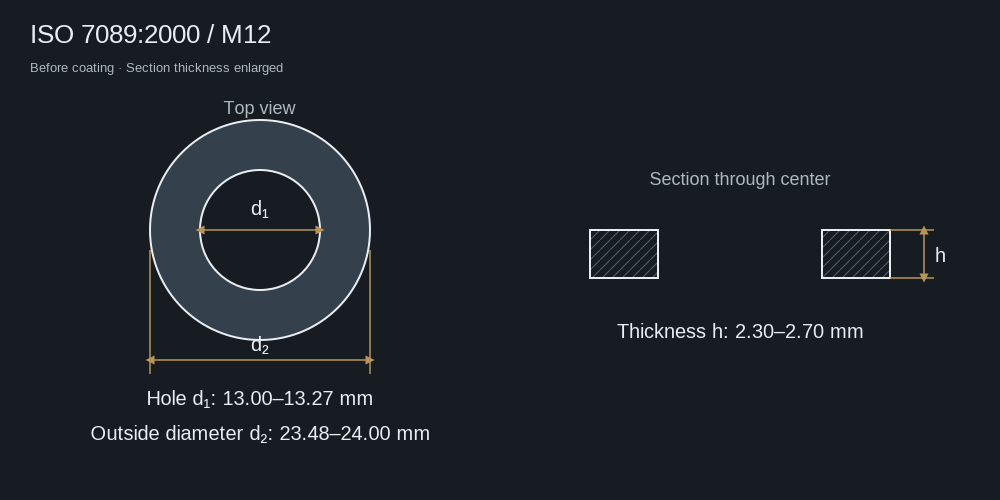
A 13.2 mm hole therefore falls within the M12 size limits. Measuring it against an assumed “12 mm washer hole” would lead to the wrong rejection. The same distinction between a nominal value and its limits applies to the outside diameter and thickness.
On a soft workpiece or across an oversized clearance hole, check how much of the washer is supported and whether it can carry the bearing load. ISO 7089 specifically calls for checking suitability in those conditions.[1]
Once the size fits, choose the hardness
Hardness becomes relevant as the bolt head or nut presses against the washer. HV denotes Vickers hardness, and the class number identifies a specified range rather than one exact reading. ISO 7089 pairs its two classes with different fastener strength levels:[1]
| Washer class | Hardness range | Hexagon bolts and screws* | Hexagon nuts* |
|---|---|---|---|
| 200 HV | 200–300 HV | Up to property class 8.8 | Up to property class 8 |
| 300 HV | 300–370 HV | Up to property class 10.9 | Up to property class 10 |
*For the product-grade-A and -B fasteners identified in ISO 7089:2000, Clause 1. Hardness ranges are from Table 3; the 300 HV steel washer is hardened and tempered.[1]
For example, moving an M12 hex-bolt assembly from class 8.8 to 10.9 can leave every washer dimension unchanged while changing the appropriate washer hardness from 200 HV to 300 HV. A dimensional inspection alone would miss that change. The standard’s stated pairing stops at class 10.9; a 12.9 assembly needs a washer specification selected for that joint.
For stainless-steel washers, A2 or A4 identifies chemical composition, while 200 HV remains the hardness requirement.[1] Include the hardness requirement when ordering an “M12 stainless washer.”
Why do DIN 125 and GB/T 97.1 appear beside ISO 7089?
These references come from different standardization systems. DIN is the Deutsches Institut für Normung, Germany’s national standards body. GB identifies Chinese national standards, and the /T in GB/T identifies a recommended, or voluntary, national standard.[3][4]
DIN 125 is the familiar legacy reference
DIN 125-1:1990-03 has been withdrawn and replaced by DIN EN ISO 7089 and DIN EN ISO 7090. In that transition, the familiar DIN 125 form A corresponds to the washer without a chamfer, while form B points to the chamfered ISO 7090 family. Form A describes the shape; it should not be confused with product grade A.[5][6][7]
The distinction most likely to affect an order is hardness. Suppliers still list DIN 125 A washers at 140 HV; Bossard’s BN 715 is one example. A 140 HV listing does not confirm the hardness class specified on an ISO 7089 order, even where the nominal dimensions match.[7] Ask the supplier to confirm ISO 7089 and the required class, 200 HV or 300 HV, rather than accepting “DIN 125 equivalent” on its own.
DIN EN ISO 7089:2000-11 is a different case: it is the German publication of the European adoption of ISO 7089:2000. The longer prefix does not describe another washer geometry.[6]
GB/T 97.1 is the Chinese counterpart
GB/T 97.1-2002 remains the current Chinese standard for these grade-A plain washers. China’s official standards record identifies it as an equivalent adoption of ISO 7089:2000, using the edition’s EQV designation.[8]
Its foreword identifies two additions to ISO 7089: packaging requirements and a simplified designation following GB/T 1237. These are differences in how the washer is specified and supplied, rather than a reason to expect a different M12 geometry. For a Chinese drawing, retain the full reference GB/T 97.1-2002 and state the size, material, hardness and finish. The neighboring GB/T 97.2 covers the chamfered form.[9]
Turn the standard into a clear order
Keep one governing standard on the order, then fill in the choices it leaves open. For a steel M12 washer paired with a class 10.9 hexagon bolt, the core designation would be Washer ISO 7089-12-300 HV, with the 2000 edition identified in the specification. Finish and quantity belong alongside it.[1]
Specify the finish separately: “ISO 7089” by itself does not select a zinc coating or define a corrosion-test requirement. If a supplier proposes DIN or GB/T stock, compare the declared hardness, material and finish as well as the dimensions before agreeing to the substitution.
Before finalizing the order, check that a normal-series washer gives the joint enough support. Our comparison of normal- and large-series washer bearing areas shows how outside diameter and the hole in the workpiece affect that decision.
References
- ISO. ISO 7089:2000, Plain washers — Normal series — Product grade A. Clauses 1 and 5; Tables 1 and 3, printed pp. 1, 3–5. Public standard preview.
- ISO. ISO 887:2000, Plain washers for metric bolts, screws and nuts for general purposes — General plan. Scope and bibliography: normal, small, large and chamfered washer families.
- DIN. DIN e. V. National standards body and organization.
- ANSI Standards Portal. Standards Used in China. National-standard prefixes and the distinction between GB and GB/T.
- DIN Media. DIN 125-1:1990-03. Withdrawal and replacement by DIN EN ISO 7089 and DIN EN ISO 7090.
- DIN Media. DIN EN ISO 7089:2000-11. German adoption of EN ISO 7089:2000. Bossard, BN 65192: chamfered washers, DIN 125 B / ISO 7090 cross-reference; compare the form-A listing in reference 7.
- Bossard. BN 715: plain washers without chamfer. Manufacturer’s catalog listing: DIN 125 A, steel, 140 HV; approximate ISO 7089 cross-reference.
- SAMR. GB/T 97.1-2002 official record. Current status and equivalent adoption of ISO 7089:2000.
- Standards Press of China. GB/T 97.1-2002, publisher’s authorized preview. National foreword, printed p. I: packaging, simplified designation and related washer standards.