
Engineering Guide · 8 min read
What Do Washers Do? Types, Functions, and Selection
Choose washers by the problem they solve: bearing pressure, elastic movement, or rotational loosening. Compare standard dimensions, hardness, and spring-load data.
The short answer: washers can spread a fastener’s bearing load, provide spring force, or help resist loosening, depending on their design. Choose the washer for the problem in the joint: a soft bearing surface, a large clearance hole, a need for elastic travel, or a fastener that can rotate loose. Matching the bolt diameter is only the first check.
A flat washer, a split washer, and a wedge-locking pair may fit the same bolt but perform different functions.
Start with the question you need to answer
- Investigating a joint that loosens? Read Do Lock Washers Work? Washers, Locking Methods and Sixty Years of Vibration Data for a closer look at vibration and locking methods.
-
Looking up an inch washer size? Use the Flat Washer Dimensions chart. Continue below for the reasons to specify the outside diameter, thickness, and hardness as well as the nominal size.
-
Specifying a split spring washer? Read Spring Washers: Uses, Sizes, and What to Specify for dimensions, standards, material and coating requirements, and the limits of its spring action.
Which problem is the washer solving?
A bolt creates preload—the initial clamping force established during tightening. The washer sits in that load path. Its function depends on how it supports the fastener and how it behaves under compression.
| Condition in the joint | Washer function to consider | What determines suitability |
|---|---|---|
| A nut or bolt head can indent the bearing surface | Spread the load with a suitable plain washer | Supported area, washer hardness, and the strength of the clamped material |
| A large clearance hole leaves too little support | Bridge the opening with a suitable large-series washer or engineered plate washer | Hole geometry, washer coverage, and resistance to bending |
| The assembly needs spring force over a small axial movement | Provide elastic travel with a selected disc spring or other spring element | Force at the installed deflection and over the required travel |
| The fastener can rotate loose under joint movement | Use a locking method suited to the joint, which may include a wedge-locking washer pair | Locking mechanism, mating surfaces, and installation conditions |
Bearing support, elastic travel, and resistance to rotation are separate requirements; a joint may need more than one.[1][3][4][6][7]
How much difference can the outside diameter make?
A washer increases the area available to carry the clamp load into the workpiece. This can reduce average bearing pressure, provided the washer is sufficiently stiff and the surrounding material supports it. Excessive bearing pressure can cause seating and a loss of preload.[1]
Compare two M12 plain-washer geometries. ISO 7089:2000 specifies the normal series; ISO 7093-1:2000 specifies the large series. The selected nominal dimensions below come from their preferred-dimension tables. They describe geometry, rather than measured dimensions of a particular production lot.[2][3]
| M12 washer | Inside diameter, mm | Outside diameter, mm | Thickness, mm |
|---|---|---|---|
| Normal series, ISO 7089:2000 | 13 | 24 | 2.5 |
| Large series, ISO 7093-1:2000 | 13 | 37 | 3 |
For a calculation example, assume a 20 kN clamp load and a 13.5 mm round hole in the workpiece. Assume rigid, flat contact across the entire supported annulus. Its area is:
A = π(D² − dₕ²) / 4; average pressure p = F / A
Here, D is the washer outside diameter and dₕ is the workpiece-hole diameter. The workpiece hole is larger than the washer bore in this example, so it determines the unsupported center. With dimensions in millimeters and force in newtons, the pressure is in N/mm², numerically equal to MPa.
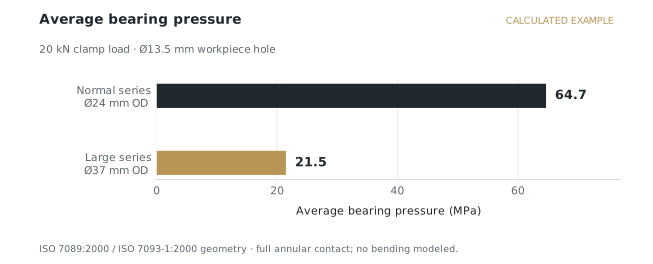
The larger geometry provides 3.01 times the nominal supported area, reducing the calculated average pressure by 66.8% at the same load. That percentage describes this geometry comparison. Actual contact pressure depends on washer bending, tolerances, and the joint surfaces.
For a large or slotted hole, check thickness and support as well as coverage. ISO 7093-1 explicitly calls for checking washer thickness when it is used over a large clearance hole. A thin washer that bends into the opening cannot deliver the rigid-contact behavior assumed above.[3]
Why does washer hardness matter?
The washer must carry the load as well as spread it. Its material and hardness affect its ability to resist indentation under the bolt head or nut. The clamped component still needs its own bearing-pressure check.[1]
For the steel plain washers covered by ISO 7089:2000 and ISO 7093-1:2000, the hardness class identifies a range. Their scope also identifies suitable pairings with hexagon bolts and screws of product grades A and B:[2][3]
| Washer hardness class | Specified hardness range | Hexagon bolt/screw property classes covered by that pairing |
|---|---|---|
| 200 HV | 200–300 HV | Up to and including 8.8 |
| 300 HV | 300–370 HV | Up to and including 10.9 |
HV denotes Vickers hardness. These pairings apply within the cited standards’ scope; they are not a universal selection table for every head shape or structural bolting system. In particular, a 12.9 bolt needs a separate washer and joint check.
State the washer hardness independently on the order. The bolt’s property class does not specify the washer, and the same nominal size can be supplied in different hardness classes.
What does “spring washer” mean in a specification?
“Spring washer” is a broad description; specify the geometry. Split spring washers form a single helical turn with the ends at different heights. Tightening compresses the washer toward flat. Conical spring washers and disc springs have a dished profile. Wave washers use a wavy profile for axial spring action.[5][8]
The following spring example is independent of the 20 kN bearing-pressure calculation. SPIROL lists a Series A disc spring measuring 25 × 12.2 × 1.50 mm (outside diameter × inside diameter × thickness), with a free height of 2.05 mm and free cone height, h₀, of 0.55 mm.[4]
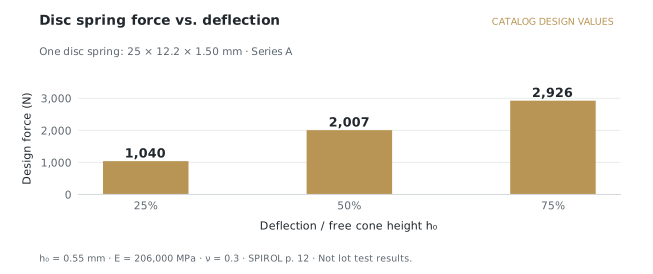
The catalog rounds the 75% deflection to 0.41 mm. Check force at the installed deflection and throughout the required travel.
Does spring action also prevent loosening?
Separate settlement from rotational loosening. Settlement reduces preload as the contact surfaces bed down or deform, even if the nut stays in the same angular position. Joint movement can also cause a screw or nut to turn loose. These mechanisms need different checks.[6]
A selected spring element can provide elastic travel to accommodate some settlement. A plain washer controls the bearing interface. A locking device addresses rotation. The word spring alone does not establish a locking function.
For the common helical split washer, NASA’s Fastener Design Manual explains that the washer is normally flat by the time the bolt is fully torqued, at which point its locking action is lost. A visible split and raised ends therefore do not establish reliable vibration resistance.[5]
Wedge-locking pairs use another mechanism. In Nord-Lock’s design, the cam faces meet inside the pair while the outer serrations grip the bearing surfaces. Attempted loosening drives movement across the cams and increases bolt tension. That mechanism depends on suitable surfaces and correct installation. The manufacturer does not recommend its Original washers on very soft mating surfaces or surfaces harder than the washers.[7]
Use the washer and locking-method comparison when vibration is the main selection problem.
Where should the washer go?
Place it at the interface whose function it must control. A plain washer used for bearing support sits between the fastener’s bearing face and the workpiece. Check each side of a through-bolted joint: the head and nut can have different bearing areas and contact different materials.
Follow the selected locking system’s instructions for a locking pair. Nord-Lock’s Original-washer guide specifies one pair under the head for a tapped-hole joint and a pair under both the head and nut for a through-hole joint. Those instructions belong to that system; apply the instructions supplied for the actual product.[7]
A washer is also an additional interface in the joint. Where a flange fastener is specified, check whether its bearing area meets the joint’s support requirement and whether a separate spring or locking function is required. Bossard identifies larger flange bearing surfaces and fewer seating interfaces as useful joint-design measures.[1][6]
What should a washer RFQ include?
“M12 washer” leaves the function, geometry, and mechanical requirements open. Carry the following details from the drawing into the enquiry:
- Type and governing document: plain, split spring, disc spring, or locking pair; product standard and edition, or drawing number and revision.
- Dimensions: nominal bolt size, inside and outside diameters, thickness, and any controlled chamfer or special shape. Include the workpiece-hole geometry where support across an opening matters.
- Material and hardness: the required material or grade and washer hardness class. For spring elements, add force at the specified deflection and the required working travel.
- Finish and assembly condition: coating designation and corrosion requirements, plus any lubricant or friction requirements used by the assembly procedure.
- Supply and inspection: quantity, lot identification, and the dimensional, hardness, coating, or spring-load results required at delivery. State whether a locking pair is ordered by the pair.
Include the mating bolt and nut specification when the supplier is quoting an assembly. How to Specify a Bolt provides the companion ordering checklist.
For a washer quotation, send the drawing and required quantity, together with the material, hardness, finish, and any spring-load or locking requirement.
References
- Bossard. Surface Pressure When Mounted, technical information, January 2025, printed pp. 53–56. Bearing pressure, seating effects, and washer selection.
- ISO. ISO 7089:2000 — Plain washers — Normal series — Product grade A. Scope, Table 1 (selected M12 dimensions), and Table 3 (hardness requirements). Standard text preview.
- ISO. ISO 7093-1:2000 — Plain washers — Large series — Part 1: Product grade A, corrected version February 2001. Scope, Table 1 (selected M12 dimensions), and Table 3 (hardness requirements). Standard text preview.
- SPIROL. Disc Springs, printed p. 12: Series A, 25 × 12.2 × 1.50 mm row and design-force table heading.
- Barrett, R. T., NASA. Fastener Design Manual, RP-1228, March 1990, printed pp. 9–10. Conical and helical spring washers; limitations of the helical split washer as a locking device.
- Bossard. Securely Fastened Joints, technical information, January 2025, printed p. 75. Settlement, rotational loosening, and constructive measures.
- Nord-Lock. Original Washers — Wedge-Locking Technology and Original Washers — User Guide. Product-specific operating principle, joint suitability, and installation.
- MW Components. Wave Spring Washers. Wave-washer geometry and use under compression in limited axial space.