
Engineering Guide · 5 min read
Stud Bolts vs Threaded Rod: ASME B18.31.2 & DIN 976-1
Compare stud bolts and threaded rod, including continuous-thread, flange and tap-end forms. Understand ASME, DIN, ASTM and ISO roles before ordering.
The short answer: a fully threaded stud and a piece of threaded rod can have the same basic shape. Full-thread studs can be made by cutting rod to length and finishing the ends. The broader stud family also includes double-end and tap-end designs. For purchasing, specify the finished geometry, length convention, thread and material requirements—the name alone does not establish interchangeability.[1][2]
Where stud bolts and threaded rod overlap
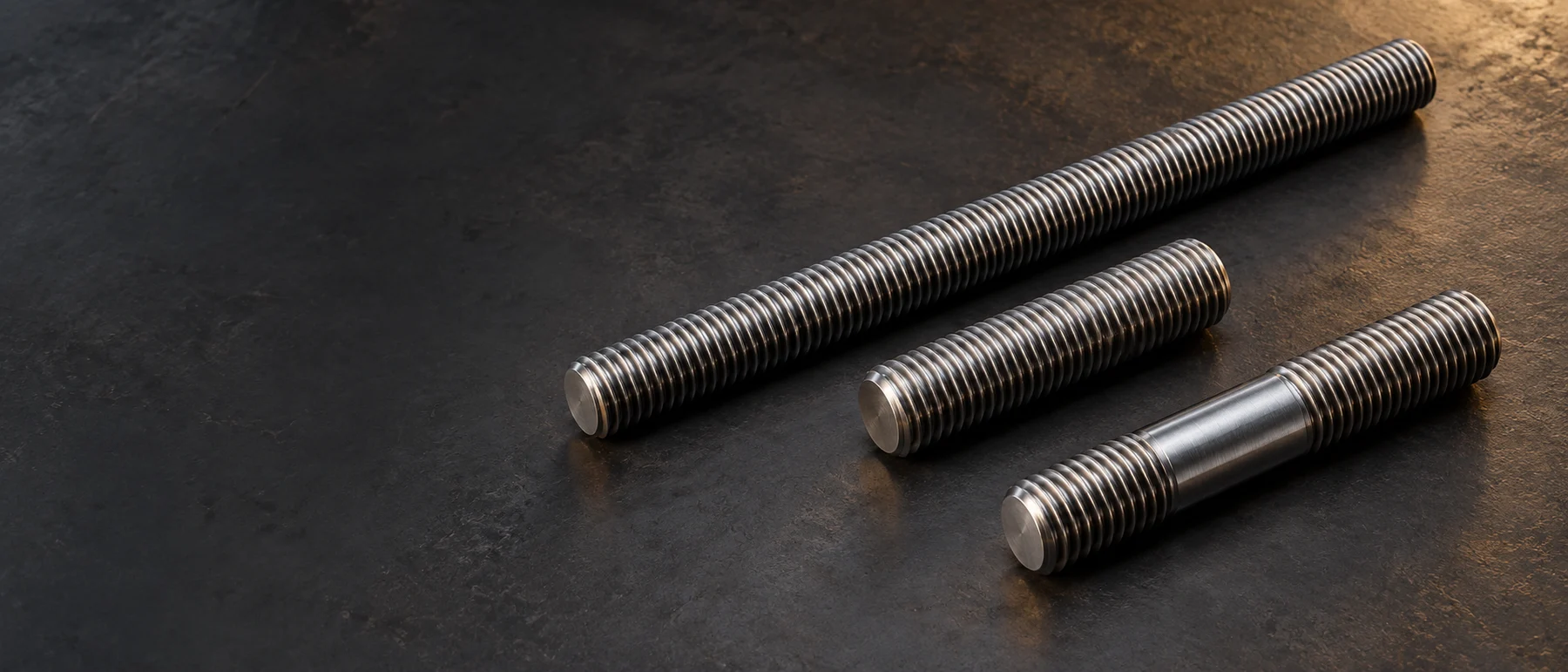
Threaded rod is often supplied in stock lengths for cutting. A continuous-thread stud is a finished headless fastener threaded along its length. Suppliers sometimes use the names interchangeably, so a photo of two fully threaded cylinders may reveal very little about their specifications.[1][2]
The useful distinction is the item being ordered. Are you buying rod stock to process, a finished stud ready to install, or a double-end part made to a drawing? A shorter piece is not automatically a compliant flange stud, and a longer piece is not automatically unsuitable. Check the requirements attached to the part.
Which stud form does the joint need?
ASME B18.31.2 distinguishes continuous-thread, flange, clamping and tap-end studs.[3]
| Form | What to identify |
|---|---|
| Continuous-thread stud | Thread along the full length; specify finished length, end preparation and thread requirements. |
| Flange bolting stud | A stud specified for flange bolting; confirm the applicable flange standard, material and length convention. |
| Double-end clamping stud | Threads of the same length and configuration at both ends, with a nut at each end to clamp the parts. |
| Tap-end stud | One end installs in a tapped hole; define the engagement end separately from the nut end. |

A tap-end stud is not simply an all-thread piece with a nut removed. Its two ends have separate jobs, and the installation end may have a different thread fit or length. ASME B18.31.2 includes both regular and interference-fit tap ends.[3]
Which standards define the shape?
Specify the product form, dimensions, material and mechanical properties. Depending on the product standard, the material and property requirements may be covered there or in a separate specification. The following references address different products; they are not an equivalence table.
| Product reference | Scope relevant to the order |
|---|---|
| ASME B18.31.2-2014 (R2019) | Inch continuous-thread, double-end and flange bolting studs.[3] |
| ASME B18.31.3-2014 (R2025) | Inch threaded rod, including the thread configurations and sizes within its scope.[4] |
| DIN 976-1:2016-09 | Stud bolts with metric threads; state the required material and mechanical specification as well.[5] |
| DIN 938:2025-08 | Metric studs with a thread length at the screw-in end of approximately one nominal diameter.[6] |
| DIN 939:2025-08 | Metric studs with a thread length at the screw-in end of approximately 1.25 nominal diameters.[7] |
Choose the standard edition required by the drawing or contract. For inch-series rod dimensions, see Threaded Rod Dimensions; the order still needs to identify the intended product form.
Where do ASTM and ISO fit?
ASTM A193/A193M specifies alloy-steel and stainless-steel bolting for high-temperature, high-pressure and other specified service. A193 Grade B7 identifies a material and property specification, not a particular stud shape or length. For grade selection, use the existing ASTM A193 and A194 Guide and B7 material guide.[8]
For metric fasteners within their scopes, ISO 898-1:2013 covers carbon- and alloy-steel property classes, while ISO 3506-1:2020 covers stainless grades and property classes. These requirements complement a product drawing or dimensional standard. They do not define a complete stud merely by naming a strength class.[9][10]
Two headless parts can therefore look alike while carrying different material, strength, thread-fit or inspection requirements. Specify the geometry and material grade required by the joint and service conditions.
Can threaded rod be cut into stud bolts?
Yes—cutting all-thread rod to length is an established way to make full-thread studs. Manufacturing may also start with a cut blank that is subsequently threaded. The finished part must meet the order, including its ends, identification and supporting material records.[1][2]
Cutting changes more than the nominal length. Agree on burr removal and end preparation so nuts can start correctly, and retain the material identity when a marked stock length becomes several pieces. Portland Bolt describes cutting, chamfering and stamping as distinct steps in preparing rod to a customer's requirements.[2]
Also define what “length” means. Overall end-to-end length and the distance between the first usable full threads describe different features on chamfered ends. Use the length convention required by the applicable standard or drawing, and label the measurement clearly.[1]
What should a stud-bolt inquiry include?
When ordering threaded rods and studs, provide these details with the drawing or RFQ:
- Form: continuous-thread, flange, double-end clamping or tap-end stud.
- Thread: diameter, pitch or TPI, tolerance class and any differences between the two ends.
- Geometry: dimensional standard and edition, length convention and tolerance, plus both thread lengths and body diameter where applicable.
- Material and assembly: the specified grade, finish, matching nuts and relevant service conditions.
- Finished-part requirements: end preparation, identification, material records and inspection documents.
For the full specification format, continue with How to Specify a Bolt. A precise stud drawing should make the form and the length measurement clear before the supplier selects or cuts the stock.
References
- Nickel Systems. Full Thread Studs. Manufacturing routes, terminology and length conventions; manufacturer guidance, not a replacement for a project specification.
- Portland Bolt. All Thread Rod Is Not Cut Equal. Stock rod, cutting, end preparation and identification.
- ASME. ASME B18.31.2-2014 (R2019). Continuous-thread, double-end and flange bolting studs, inch series; public scope and configuration descriptions.
- ASME. ASME B18.31.3-2014 (R2025). Threaded rods, inch series; public scope.
- DIN Media. DIN 976-1:2016-09. Stud bolts, metric thread; public scope.
- DIN Media. DIN 938:2025-08. Studs, metal end approximately 1d; public scope.
- DIN Media. DIN 939:2025-08. Studs, metal end approximately 1.25d; public scope.
- ASTM International. ASTM A193/A193M-25. Alloy-steel and stainless-steel bolting for high-temperature or high-pressure service and other special-purpose applications; public abstract.
- ISO. ISO 898-1:2013. Mechanical and physical properties of carbon- and alloy-steel bolts, screws and studs within its scope.
- ISO. ISO 3506-1:2020. Stainless-steel bolts, screws and studs with specified grades and property classes; public scope.