
Engineering Guide · 7 min read
Grade 5 vs Grade 8 Bolts: Strength, Markings and Applications
Compare SAE J429 Grade 5 and Grade 8 bolt strength, three-line and six-line head markings, applications, torque limits and mating-hardware checks.
The short answer: for the common 1/4–1 in diameter range, an SAE J429 Grade 5 bolt has a 120 ksi minimum tensile strength and an 85 ksi proof strength; Grade 8 raises those values to 150 ksi and 120 ksi. Grade 5 is identified by three radial lines on the head, Grade 8 by six. Choose Grade 8 when the joint is designed to use the extra preload or tensile capacity. Choose Grade 5 when its load capability is sufficient. The stronger bolt is not an automatic upgrade if the nut, tapped hole, washer, clamped material or tightening method is the limiting part of the joint.[1] [2] [3]
These are SAE inch grades, not metric classes
In this comparison, Grade 5 and Grade 8 mean the strength grades in SAE J429:2014. The standard covers mechanical and material requirements for inch-series steel bolts, screws, studs, sems and U-bolts used in automotive and related industries, in sizes through 1 1/2 in.[1]
The grade does not define the bolt's dimensions or thread pitch. A typical hex cap screw may use ASME B18.2.1 dimensions and an ASME B1.1 UNC or UNF thread, while SAE J429 supplies the material, heat-treatment, mechanical-property and marking requirements.[6] [7]
That distinction prevents two common ordering errors:
- SAE Grade 8 is not metric property class 8.8. The similar-looking numbers belong to different systems.
- Steel SAE Grade 5 is not titanium Grade 5. Titanium grade numbers identify alloy families, not the J429 strength level.
How much stronger is Grade 8?
The main difference is the minimum stress each grade must withstand. Grade 8 stays at the same listed strength across the J429 diameter range shown below; Grade 5 steps down above 1 in diameter.[1] [2] [3]
| SAE J429 grade and nominal diameter | Proof strength | Minimum yield strength | Minimum tensile strength |
|---|---|---|---|
| Grade 5, 1/4–1 in | 85 ksi | 92 ksi | 120 ksi |
| Grade 5, over 1–1 1/2 in | 74 ksi | 81 ksi | 105 ksi |
| Grade 8, 1/4–1 1/2 in | 120 ksi | 130 ksi | 150 ksi |
What the numbers mean: proof strength is the specified stress a compliant fastener must sustain in the proof-load test without permanent set. Yield is the onset of permanent deformation; tensile strength is the maximum tensile stress reached in the test. All three are stresses, not the load rating of an individual bolt. Actual force capacity also depends on the thread's tensile stress area.
For diameters through 1 in, Grade 8 provides 25% more minimum tensile strength than Grade 5 and about 41% more proof strength. The proof-strength increase matters because a properly engineered tightening specification is normally kept below the level that would permanently stretch the fastener.
Grade 5 is commonly produced from quenched-and-tempered medium-carbon steel. Grade 8 uses quenched-and-tempered medium-carbon alloy steel and is harder as well as stronger. Published J429 summaries show a typical Grade 5 core-hardness range of HRC 25–34 and Grade 8 of HRC 33–39 for the common sizes represented in their comparison.[2] [3]
Read the head markings before the finish
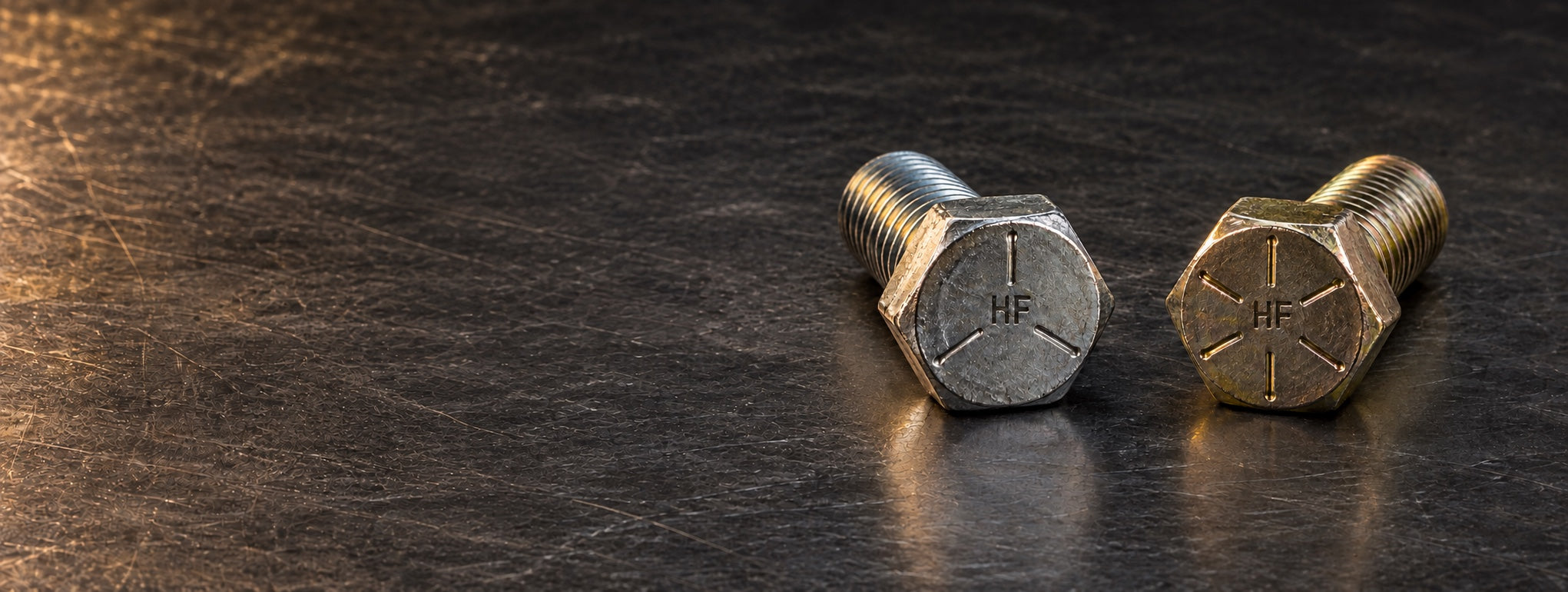
On a hex-head J429 fastener, count the radial grade lines:
| Head marking | Grade | Quick interpretation |
|---|---|---|
| Three radial lines, spaced 120° apart | SAE Grade 5 | Medium-strength, quenched-and-tempered steel |
| Six radial lines, spaced 60° apart | SAE Grade 8 | High-strength, quenched-and-tempered alloy steel |
The head should also carry the manufacturer's identification. The maker mark may sit between the grade lines or move to another clear position; it is not part of the line count.[2] [3]
Color is not a grade identifier. Clear zinc, yellow zinc, black oxide, black zinc and other finishes can appear on different strength grades. A gold-colored bolt is not automatically Grade 8, and a black bolt is not automatically alloy steel. Read the head, then confirm the purchase specification and certification.
Studs, U-bolts, small heads and special products can use different marking provisions. For a critical replacement, do not infer the grade from appearance alone when the required mark is missing or unreadable.
Where Grade 5 usually fits
Grade 5 is the practical starting point for many automotive, agricultural and general machinery joints when its proof load provides the required preload with design margin. Examples include brackets, equipment frames, guards and serviceable assemblies whose drawings already call out J429 Grade 5.
Its main advantage is not that it is “soft.” It is a heat-treated fastener with substantially more capacity than low-strength general-purpose hardware. The reason to keep Grade 5 is simpler: once it meets the joint load, moving to Grade 8 may add cost and process requirements without improving the assembly.
Where Grade 8 earns its place
Grade 8 is appropriate when the design needs more clamp load or tensile capacity from the same nominal diameter. That can matter in compact machinery, drivetrain and suspension assemblies, heavy equipment and other joints where space prevents increasing bolt size. SAE fasteners are widely used in vehicles, agricultural, construction and mining equipment, but the equipment drawing—not the industry label—determines the required grade.[3]
The joint must be able to accept the higher preload. Check the female thread, nut proof load, washer, bearing surface and clamped material. Driving a Grade 8 bolt harder into a short aluminium tapped hole can strip the parent thread before the bolt reaches its intended load. A soft plate can also embed under the head or nut, reducing clamp load after assembly.
Choose by the joint, not by the grade number
| Decision condition | Better starting point | Required check |
|---|---|---|
| Existing OEM or engineering drawing names a grade | Use the specified grade | Confirm revision, size, thread and finish before substitution |
| Grade 5 supplies the required preload and margin | Grade 5 | Verify actual fastener area, external load and installation method |
| More preload is needed without increasing diameter | Grade 8 | Verify nut, internal thread, washer and bearing surface |
| Joint is exposed to repeated transverse movement | Neither grade solves it alone | Control preload, joint slip and the locking method |
| Structural steel connection | Use the project structural-bolting specification | Do not substitute J429 solely because tensile numbers look similar |
| Elevated-temperature or pressure service | Use the governing service specification | J429 is not a substitute for temperature-rated bolting requirements |
A higher static tensile value does not guarantee longer fatigue life. In a preloaded joint, the bolt and clamped parts act as springs; joint stiffness and retained clamp load determine how much of a fluctuating external load reaches the bolt. NASA's Fastener Design Manual shows why preload, joint stiffness and separation govern cyclic bolt loading.[5]
Grade changes the preload range, not the torque coefficient
Grade 8 can support a higher target preload, but the grade stamp does not provide a universal torque value. Torque is consumed mainly by friction in the threads and under the rotating bearing surface. Zinc plating, black oxide, topcoat, oil, thread-locking compound and reuse can all change the torque needed to reach the same clamp load.[5]
This is why copying a torque number from a generic chart is risky. Use the actual diameter, thread series, grade, finish, lubricant and nut or tapped-hole condition. For important joints, validate torque against clamp load with the production fastener system.
The same rule applies when “upgrading” an existing assembly. Installing Grade 8 at a Grade 5 torque usually leaves much of the extra bolt capacity unused. Raising the torque without checking the mating parts can damage the joint.
Pair the nut and washer with the bolt
SAE J995 covers three grades of steel nuts for automotive and related engineering applications from 1/4 to 1 1/2 in, with dimensions tied to SAE J482 or ASME B18.2.2.[4] Specify a nut with sufficient proof-load capability for the selected bolt; a compatible J995 Grade 8 nut is the normal starting point for a J429 Grade 8 bolt.
Washer hardness and bearing area matter when preload rises. A washer that dishes or a clamped surface that crushes can relax the joint even when the bolt itself remains elastic. Treat the bolt, nut or tapped thread, washer and bearing surfaces as one fastener system.
What to put on the RFQ or drawing
- SAE J429 grade and current required revision
- Fastener type and dimensional standard, such as ASME B18.2.1 hex cap screw
- Complete inch thread callout: diameter, TPI, UNC or UNF, and class of fit
- Length, grip and thread-length requirements
- Matching nut specification and grade; washer type and hardness where needed
- Coating or finish, corrosion requirement and lubricant condition
- Target preload or validated tightening method for controlled joints
- Inspection report, lot traceability and head-marking requirements
Need the thread or metric comparison next? Read UNC and UNF Threads: How Pitch Changes Joint Performance, or see Bolt Grades 8.8, 10.9 and 12.9 for the metric property-class system.
References
- SAE International. SAE J429_201405 — Mechanical and Material Requirements for Externally Threaded Fasteners. Scope and current verified revision.
- Portland Bolt. SAE J429 Strength Requirements. Diameter-dependent Grade 5 and Grade 8 proof, yield, tensile and hardness requirements.
- Earnest Machine. Head Markings for Bolts and Screws Explained. SAE grade marks, materials, hardness ranges and typical industry use.
- SAE International. SAE J995_201707 — Mechanical and Material Requirements for Steel Nuts. Nut scope and dimensional references.
- Richard T. Barrett, NASA Reference Publication 1228. Fastener Design Manual. Preload, joint stiffness, fatigue and torque fundamentals.
- ASME. ASME B18.2.1-2012 (R2021) — Square, Hex, Heavy Hex, and Askew Head Bolts and Hex, Heavy Hex, Hex Flange, Lobed Head, and Lag Screws. Inch-series product dimensions.
- ASME. ASME B1.1-2024 — Unified Inch Screw Threads. Thread form, series, class, allowance, tolerance and designation.