
Engineering Guide · 6 min read
Spring Washers: Uses, Sizes, and What to Specify
Read split spring washer dimensions, check DIN, GB, and ASME references, and specify material, hardness, and coating while recognizing the limits of spring action.
The short answer: a split spring washer is a single-turn helical ring that acts as a spring while it is compressed under a bolt head or nut. It is normally flat by the time the bolt is fully tightened and provides no effective locking action in that condition.[1] When replacing one in an existing assembly, match the specified part and washer stack. For a new joint, establish the required locking or spring behavior before choosing a washer by its size and shape.
This article covers ordinary split spring washers. Disc springs and wave washers have different geometries and spring characteristics; the washer selection guide explains where those designs fit. For a comparison of locking methods, see Do Lock Washers Work?.
What does a split spring washer do?
Before tightening, the offset ends make the washer taller than its material thickness. As the nut or bolt head advances, it compresses the ring toward flat. Spring action during that movement is easy to see; what matters in service is the elastic travel remaining at the installed clamp load.
NASA’s Fastener Design Manual explains that an ordinary helical spring washer is normally flat by the time a bolt is fully torqued and provides no effective locking action in that condition.[1]
A free-height dimension tells you the washer’s unloaded shape; a load–deflection specification tells you its spring behavior. A joint that needs spring force over an axial movement needs force values at defined installed heights. The dimensional catalog below answers the separate question of what part will fit.
How do you read spring-washer dimensions?
An M12 designation identifies the mating fastener size. The washer bore is larger to provide clearance, and the outside diameter determines how much room it occupies beneath the head or nut. Section width, material thickness, and free height complete the description of the ring.
These selected DIN 127 form B, spring-steel dimensions are Güde catalog limits, in millimeters. Symbols: d, bore; D, outside diameter; b, radial section width; s, material thickness; h, free height.[2]
| For bolt | Bore d, min.–max., mm | Outside D, max., mm | Width b, min.–max., mm | Thickness s, min.–max., mm | Free height h, min.–max., mm |
|---|---|---|---|---|---|
| M6 | 6.10–6.50 | 11.80 | 2.35–2.65 | 1.50–1.70 | 3.20–3.80 |
| M8 | 8.10–8.50 | 14.80 | 2.85–3.15 | 1.90–2.10 | 4.00–4.70 |
| M12 | 12.20–12.70 | 21.10 | 3.80–4.20 | 2.35–2.65 | 5.00–5.90 |
The chart separates the two axial dimensions that are easiest to confuse:
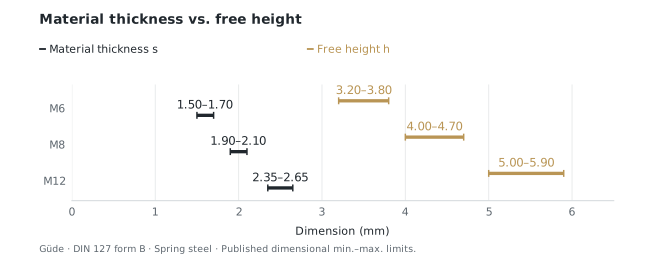
Measure s through the material section and h across the full unloaded height. A measurement across the raised ends checks free height, rather than the thickness of the steel. These remain separate dimensions on the finished-part drawing, including any coating allowance.
Which standard belongs on the order?
The dimensions above belong to a DIN 127 form B catalog product. A part ordered to GB/T 93 or an ASME inch series has to be identified by that specification’s own form or series and limits. The standard number and edition therefore belong with the size:
| Reference | What to check before ordering |
|---|---|
| DIN 127:1987-10 | DIN Media marks this edition withdrawn. Manufacturers continue to list products under the DIN 127 designation, including the form B product used above.[2][3] |
| GB/T 93-2025 | China’s current normal-type single-coil spring-lock-washer standard. It replaced GB/T 93-1987 effective February 1, 2026.[4] |
| ASME B18.21.1-2009 (R2016) | Covers inch-series washers, including helical spring-lock washers. Its dimensional tables distinguish regular, heavy, extra-duty, and high-collar series.[5] |
A withdrawn standard can still identify the part required by an existing assembly drawing. Changing to a current standard calls for a comparison of dimensions and material requirements; updating the number alone can change the component being supplied.
ASME B18.21.1 covers the washer’s dimensions, physical properties, and related test methods. Its product note also cautions that the historical word lock does not imply permanent fixation.[5]
What material, hardness, and coating should you specify?
The catalog identifies spring steel and a hardness range of 430–530 HV, where HV denotes Vickers hardness.[2] A substitution described only as “steel” or “stainless” leaves the grade and mechanical condition unresolved.
That material condition matters when a coating is applied. Bossard flags hydrogen-embrittlement risk for electroplated hardened spring elements. Acid cleaning and electroplating can introduce hydrogen; subsequent baking reduces the risk but does not guarantee its removal.[6]
An electroplated-washer specification therefore needs to address how hydrogen-embrittlement risk will be controlled and documented. For an alternative finish, the comparison includes surface preparation, its effect on finished dimensions, and the corrosion requirement. “Zinc” alone leaves the coating process open.
Where are split washers appropriate—and where is another solution needed?
For a replacement, the specified part and washer stack establish the starting point. A new design needs a choice based on the function required in the joint:
| Your task | What to specify or review |
|---|---|
| Replace a washer on an existing bill of materials | Reproduce the specified component and washer-stack arrangement. |
| Reduce loosening under vibration or repeated joint movement | Review preload, joint movement, bearing surfaces, and a locking method tested under relevant conditions. Use the locking-method comparison to examine the options. |
| Maintain force while accommodating axial movement | Use a spring element with specified force over the required travel, supported by load–deflection data. |
| Spread load over a soft surface or bridge an opening | Provide enough bearing area and bending stiffness for the workpiece and hole. The washer selection guide covers that separate function. |
For the replacement task above, stack arrangement and reuse are part of the assembly specification. Where the drawing shows both a plain washer and a split washer, their order determines which part bears on the workpiece. Adding another washer changes the stack height and introduces another contact interface.
A washer that springs open after removal may still be out of specification. Reuse depends on the part specification and the assembly’s replacement rules.
What should a spring-washer RFQ include?
An inquiry for “M12 spring washer, zinc” leaves the form or series, material, hardness, and zinc-coating specification unresolved. Send the following fields with the drawing:
| RFQ field | Information to provide |
|---|---|
| Product identity | Split spring-lock washer; governing standard and edition; form or series; drawing number and revision |
| Size and geometry | Nominal bolt size; required bore, outside diameter, section width, material thickness, and free-height limits |
| Material and condition | Material grade, heat treatment where specified, and hardness requirement |
| Finish | Coating designation, required corrosion results, dimensional allowances, and applicable process controls |
| Delivery and inspection | Quantity, lot identification, and required dimensional, hardness, material, or coating records |
| Functional requirements, if specified | Force at defined installed heights, test conditions, and acceptance limits; any approved assembly or vibration test requirement |
Ask the supplier to identify the offered part and list any deviations in its quotation. Inspect the delivered lot against the approved specification, checking material thickness and free height separately.
Send the drawing and quantity for a spring-washer quotation.
References
[1] Richard T. Barrett, Fastener Design Manual, NASA RP-1228, 1990, printed p. 9, “Lockwashers.”
[2] Güde GmbH, DIN 127 form B — Split Lock Washers, undated spring-steel product sheet.
[3] DIN Media, DIN 127:1987-10, publisher’s record and withdrawn status.
[4] State Administration for Market Regulation / Standardization Administration of China, GB/T 93-2025, Fasteners—Single coil spring lock washers—Normal type, official record: effective February 1, 2026; replaces GB/T 93-1987. Used here for scope and status, not dimensional values.
[5] ASME, B18.21.1-2009 (R2016), Washers: Helical Spring-Lock, Tooth Lock, and Plain Washers (Inch Series), publisher’s scope and product note; publisher’s contents preview, tables 1–4.
[6] Bossard, Notes on Use and Hazard Symbols, “Residual Risks”: electroplated hardened spring elements, hydrogen embrittlement, and the limits of baking.
Source status checked October 20, 2026.