
Engineering Guide · 6 min read
Do Lock Washers Work? Washers, Locking Methods and Sixty Years of Vibration Data
Transverse vibration, not axial load, loosens bolted joints — and the helical split lock washer has failed that test since 1969. What each washer and locking method actually does, with data from Junker, NASA and DIN.
The short answer: some do, and the most common one doesn't. A bolted joint stays tight because of the preload stretched into it at assembly — not because of the hardware under the nut. A locking device earns its name only if it stops rotation or keeps preload from draining away, and judged on those two jobs the helical split lock washer has failed standardized vibration testing since 1969. The methods with evidence behind them are prevailing-torque nuts, wedge-lock washers and threadlocker.
Part of the washer selection guide.
How a joint actually loosens
A tightened bolt is a stretched spring. As long as the threads and bearing surfaces hold by friction, the stored energy has nowhere to go — so "locking" is really the question of what it takes to make one of those surfaces slip.
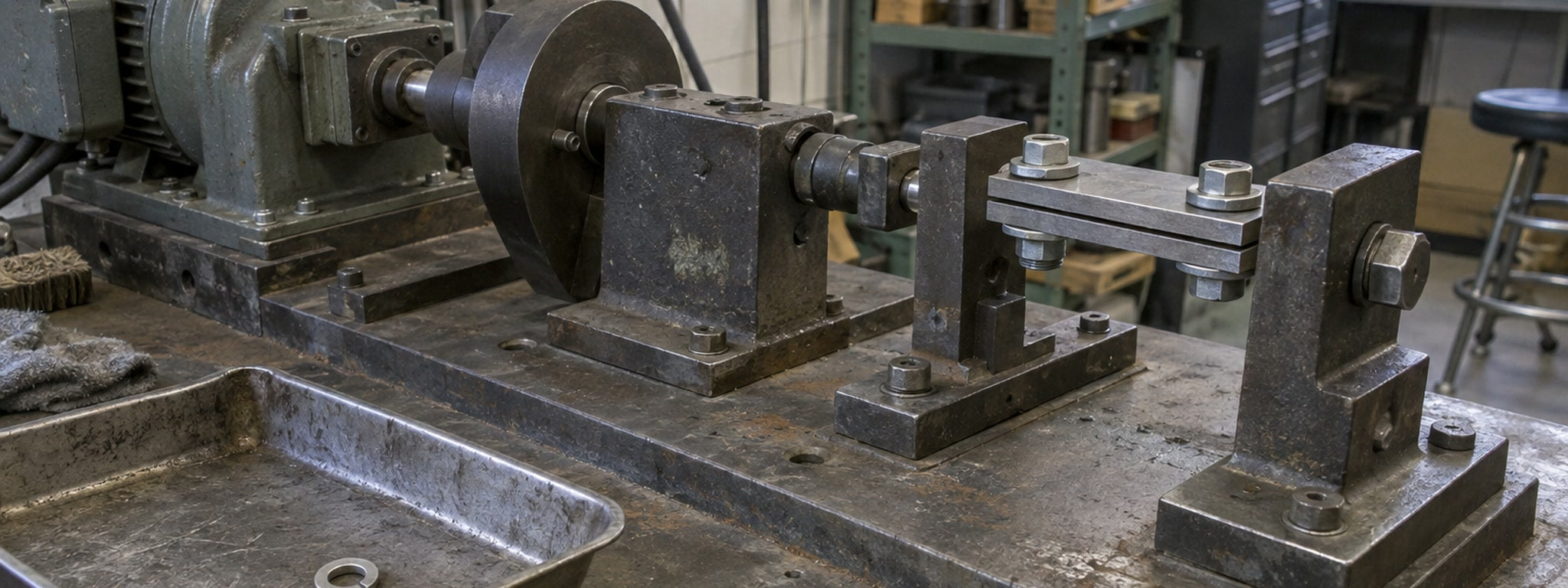
Gerhard Junker found the answer in the 1960s, and it wasn't intuition's. Axial vibration almost never loosens a joint. Transverse movement — the clamped parts sliding sideways — breaks friction at the threads and under the head in the same instant, and the bolt's own torsional strain then winds the nut back, a degree at a time.[1] The Junker test, later codified as DIN 65151, does exactly this: it shakes a joint sideways and plots preload against cycles, so locking devices can be compared on a curve rather than a datasheet claim.
Preload also disappears without any rotation: paint squeezes out, surface roughness beds in, soft coatings creep. Engineers call this embedding or settlement, and it does its damage in the first hours of service. Rotation and settlement need different hardware — a device that stops one does nothing for the other. Keep that distinction in mind as we walk the washer shelf.
What each washer actually does
Every washer on a purchase order is doing one of three things: spreading load, preserving preload, or resisting rotation. Here is what the common types genuinely deliver:
| Hardware | Real function | What the evidence says |
|---|---|---|
| Flat washer | Spreads bearing load, protects the surface, bridges oversized holes | No locking function whatsoever — and none is claimed in its standards |
| Helical split lock washer | Intended to spring and bite | Flattens at 10–20% of target preload on class 8.8+ bolts, then acts as a plain washer; Junker tests show it fails to prevent loosening and can accelerate it[1] [2] |
| Tooth / star lock washer | Teeth bite bolt head and mating surface | Some locking action, at the cost of damaging both surfaces[3] |
| Conical spring washer (DIN 6796) | Spring element sized to flatten near target preload | Legitimate against embedding and relaxation losses — not against rotational loosening[2] |
| Wedge-lock washer pair (DIN 25201) | Mating cams with an angle steeper than the thread pitch; loosening rotation lifts the cams and increases tension | Locks by geometry rather than friction; retains preload through severe transverse vibration |
The wedge-lock pair deserves a closer look, because it inverts the friction idea. The two washers sit cams-to-cams, teeth facing out; the teeth grip the bolt head and the joint while the cams float in between. If the nut tries to rotate loose, it must climb a cam ramp steeper than the thread's own helix — loosening takes more torque than tightening, and any attempt adds tension instead of relieving it. That is why this geometry survives Junker tests that destroy every friction-based competitor.
The case against the split lock washer
The spring washer has been in use for over a century, and the verdict has been building for half of that time. What is remarkable is how consistently three independent institutions reached the same conclusion.
Junker was first, in 1969: joints with a spring washer loosened like joints without one, and later tests showed they can loosen faster — the extra interface gives slip one more place to start.[1] [2] NASA put it bluntly in its 1990 Fastener Design Manual: the washer is flat long before full torque, making it "equivalent to a solid flat washer, and its locking ability is nonexistent" — in the manual's summary, "useless for locking."[3] DIN acted in 2004, withdrawing the dimensional standards for spring and similar lock washers so designers would stop specifying parts shown to be ineffectual.[2]
None of this makes split washers contraband. On a static joint where preload retention doesn't matter, they are harmless. The mistake is not using one — it is relying on one, writing it into a drawing as the locking device for a joint that moves.
Methods that hold up
State the requirement as a function — resist rotation, survive heat, allow disassembly — and the hardware mostly selects itself:
| Requirement | Proven approach | Watch out for |
|---|---|---|
| Static joint, cosmetic surface | Flat washer + correct torque | Torque accuracy is the locking device here |
| Vibration, general machinery | Wedge-lock washer pair (DIN 25201) or prevailing-torque locknut | Wedge-lock pairs install as a unit, cams facing each other |
| Frequent disassembly | Wedge-lock pair or all-metal deformed-thread nut | Nylon inserts lose prevailing torque with reuse; NASA rates deformed-thread nuts at roughly 10 reuses[3] |
| Service above ~120 °C (250 °F) | All-metal locking — not nylon inserts or patches | Nylon's temperature ceiling[3] |
| Embedding-prone stack (paint, soft coatings, short grip) | Conical spring washer (DIN 6796) plus a locking method | Belleville-type washers handle settlement, not rotation |
| Permanent assembly, no disassembly planned | Threadlocker adhesive | Correct grade for the service temperature and gap |
The pattern: against rotation, use geometry or chemistry — never spring steel shaped like a washer. Against settlement, only a real spring element helps, which is exactly what DIN 6796 conical washers are rated for.
Field notes
- Preload first, hardware second. Every method above assumes a calibrated tool and a real preload. A well-tightened plain joint outperforms a poorly tightened "locked" one.[1]
- Do not stack locking devices. A split washer under a wedge-lock pair feels like insurance; in practice it adds a flattening interface that undermines both.
- Lubrication changes the equation. An oiled thread converts the same torque into much higher preload — choose the torque spec and the locking method together, not separately.
- Jam nuts are not a locking strategy. The double-nut arrangement is so sensitive to which nut carries the load that NASA's manual calls it too unpredictable to be reliable.[3]
What to put on the RFQ
The most useful line in a fastener enquiry is the one nobody writes: what the joint experiences. "Sees transverse vibration," "rebuilt monthly," "120 °C continuous" — each sentence selects the locking method by itself, before part numbers come up. Our washer range covers flat washers, split washers for the static cases where they belong, and DIN 25201 wedge-lock pairs for the ones that move; locknuts include nylon-insert and all-metal types. Unsure which fits your joint? Describe the load case and we will recommend a method before quoting.
Related reading: 304 vs 316 Stainless Steel Fasteners: What the Data Says covers material selection for corrosive service, and UNC and UNF Threads explains why thread pitch changes vibration behaviour.